Drama

Sagebrush Trail (1933)

3/5 (1)

“Sagebrush Trail” is a 1933 Western film directed by Armand Schaefer and starring John Wayne. The movie follows the story of John Brant, a man wrongfully accused of robbery and murder. He escapes from prison and goes on the run, trying to clear his name and find the real culprits.

Brant is pursued by the law, as well as by the real criminals, who want to silence him for good. Along the way, he meets a young woman named Sally Blake, who is also on the run from the law, and they team up to try to find the evidence that will prove Brant’s innocence.

The two encounter many obstacles, including gunfights and horseback chases, as they try to outsmart the bad guys and evade the law. In the end, Brant is able to clear his name and bring the real criminals to justice, while also finding love with Sally.

The film is notable for being one of John Wayne’s earliest starring roles, and it helped establish him as a leading man in Hollywood. It also features many of the classic Western tropes, including shootouts, horseback riding, and rugged, lawless landscapes.

Directors:
Armand Schaefer

Writer:
Lindsley Parsons, Will Beale

Stars:
John Wayne, Nancy Shubert, Lane Chandler

Rate this Movie

Call of the Yukon (1938)

4/5 (3)

“Call of the Yukon” is a 1938 adventure film directed by B. Reeves Eason and starring Richard Arlen, Beverly Roberts, and Lorna Gray.

The movie tells the story of Bob Mason (Richard Arlen), a pilot who is sent to the Yukon to retrieve a valuable cargo of furs from a remote trading post. Along the way, Bob meets Marie (Beverly Roberts), the daughter of the trading post owner, and the two quickly fall in love.

However, their romance is complicated by the presence of John Hudson (William C. McGann), a rival pilot who is also vying for Marie’s affections. As Bob and John compete for the cargo and Marie’s love, they face a number of dangers in the harsh wilderness of the Yukon, including treacherous weather, wild animals, and hostile natives.

The film features breathtaking footage of the Alaskan wilderness and thrilling action sequences, including a dramatic plane crash and a chase on dog sleds. In the end, Bob proves his courage and loyalty as he fights to protect Marie and the cargo from those who would do them harm. “Call of the Yukon” is a classic adventure film that captures the rugged beauty and perilous nature of the Yukon wilderness.

Directors:
B. Reeves Eason, John T. Coyle

Writer:
Gertrude Orr, Bill Peet, James Oliver Curwood

Stars:
Richard Arlen, Beverly Roberts, Lyle Talbot

Rate this Movie

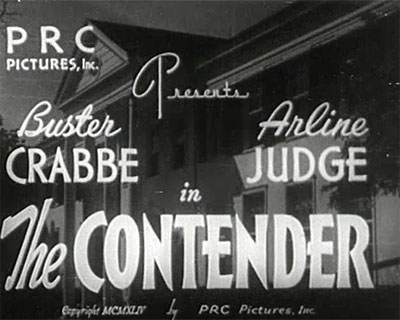
The Contender (1944)

3/5 (1)

“The Contender” is a novel written by Robert Lipsyte and published in 1967. However, there is also a movie titled “The Contender” which was released in 1944, and I assume that’s the one you are referring to.

The 1944 film “The Contender” is a drama directed by Sam Newfield and starring Buster Crabbe, Arline Judge, and Julie Gibson. The plot centers around Johnny Rocket (Buster Crabbe), a washed-up boxer who gets a chance at a comeback when a new manager, Dave Leonard (Milton Kibbee), takes him under his wing. Johnny’s love interest, Peggy (Arline Judge), is also a key character in the story.

As Johnny trains and fights his way back to the top, he faces a number of challenges, including a rival boxer named Kid Norfolk (Jack Ingram), who wants a shot at the title. Johnny also has to contend with a crooked promoter who wants to fix the fight in his favor.

In the end, Johnny gets his chance at the title, but not before facing some tough decisions and personal sacrifices. The film explores themes of redemption, love, and perseverance, and is a classic example of the boxing movie genre popular during the 1940s.

Directors:
Sam Newfield

Writer:
George Wallace Sayre, Jay Doten, Raymond L. Schrock

Stars:
Buster Crabbe, Arline Judge, Julie Gibson

Rate this Movie

Hot Rod Girl (1956)

3/5 (1)

“Hot Rod Girl” is a classic American film from 1956 that follows the story of a young woman named Lori Nelson who becomes involved in the dangerous world of hot rod racing.

Nelson’s character, named “Gloria,” is a rebellious teenager who falls in love with a young hot rod racer named “J.D.” (played by Chuck Connors). J.D. is the leader of a gang of young racers who are constantly pushing the limits of their cars and endangering their lives in the process.

As Gloria becomes more involved with J.D. and his gang, she also becomes more aware of the dangers and risks involved in hot rod racing. When J.D. becomes involved in a dangerous street race with a rival gang, Gloria must try to convince him to give up his dangerous lifestyle and settle down with her.

The film features a number of exciting and dramatic racing scenes, as well as some tense moments as Gloria and J.D. navigate their relationship and try to find a way to balance their love for each other with their passion for racing.

Overall, “Hot Rod Girl” is a thrilling and entertaining film that captures the spirit of teenage rebellion and the excitement of hot rod racing in the 1950s.

Directors:
Leslie H. Martinson

Writer:
John McGreevey

Stars:
Lori Nelson, Chuck Connors, John Smith

Rate this Movie

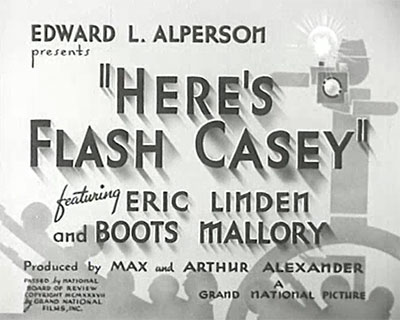
Here’s Flash Casey (1938)

3/5 (1)

“Here’s Flash Casey” is a 1938 crime drama directed by Lynn Shores and starring Eric Linden, Boots Mallory, and C. Aubrey Smith. The film follows the story of a newspaper photographer who becomes embroiled in a dangerous criminal plot.

The film centers around Flash Casey (Eric Linden), a young and ambitious newspaper photographer who is always looking for the next big scoop. When a notorious gangster is murdered, Flash sees it as a chance to make a name for himself and sets out to investigate the case. Along the way, he meets a beautiful woman named Miss Foster (Boots Mallory), who may have information about the killer.

As Flash delves deeper into the case, he becomes the target of the gangster’s henchmen, who will stop at nothing to protect their boss’s interests. Flash must use all of his wits and cunning to stay one step ahead of the criminals and uncover the truth behind the murder.

Flash is aided in his investigation by his editor, Pappy (C. Aubrey Smith), who provides him with valuable information and guidance. Together, they work to expose the criminal plot and bring the murderers to justice.

“Here’s Flash Casey” is a thrilling crime drama with a fast-paced plot and a strong cast. It explores themes of corruption, power, and the power of the press. The film remains a classic example of the crime film genre of the 1930s and is a must-see for fans of the genre.

Directors:
Lynn Shores

Writer:
John W. Krafft, George Harmon Coxe

Stars:
Eric Linden, Boots Mallory, Cully Richards

Rate this Movie

Crime, Inc. (1945)

3/5 (1)

“Crime, Inc.” is a 1945 crime film directed by Lew Landers and starring Leo Carrillo, Tom Neal, and Martha Tilton. The film tells the story of a journalist who goes undercover to expose a powerful organized crime syndicate.

The film follows the story of Tom Dean (Tom Neal), a newspaper reporter who is assigned to investigate a string of brutal murders that are believed to be the work of a powerful criminal organization. To get to the bottom of the case, Tom goes undercover and poses as a small-time crook looking to join the syndicate.

Tom soon discovers that the syndicate is run by a ruthless boss named “Mr. Big” (Leo Carrillo), who will stop at nothing to protect his interests. Tom’s investigation takes him deep into the criminal underworld, where he meets a cast of colorful characters, including a nightclub singer named Lila (Martha Tilton) who becomes his ally.

As Tom gets closer to uncovering the truth, he becomes the target of the syndicate’s deadly enforcers. He must use all of his wits and resourcefulness to stay alive and bring the criminals to justice.

“Crime, Inc.” is a gripping crime thriller with a noirish atmosphere and a strong cast. It explores themes of corruption, power, and the struggle between good and evil. The film remains a classic example of the crime film genre of the 1940s and a must-see for fans of the genre.

Directors:
Lew Landers

Writer:
Raymond L. Schrock, Martin Mooney

Stars:
Leo Carrillo, Tom Neal, Martha Tilton

Rate this Movie

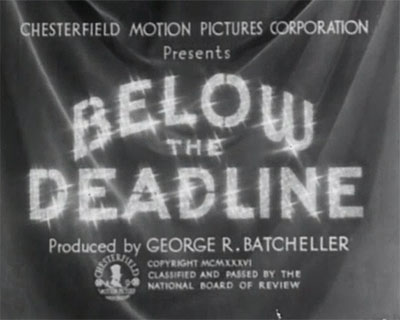
Below the Deadline (1936)

3/5 (1)

“Below the Deadline” is a 1936 crime drama directed by Charles Lamont and starring Warren Hull, Doris Weston, and Henry Mollison. The film follows the story of a newspaper reporter who investigates a murder case and uncovers a web of deceit and corruption.

The film centers around Tom Dickson (Warren Hull), a young reporter who works for a struggling newspaper. When a prominent businessman is found murdered in his office, Tom sees it as a chance to make a name for himself and sets out to investigate the case. He soon discovers that the victim was involved in a shady real estate deal and that several people had a motive for his murder.

As Tom delves deeper into the case, he becomes the target of a powerful criminal organization that is determined to stop him from uncovering the truth. He is aided in his investigation by his girlfriend, Grace Bradshaw (Doris Weston), and his editor, Bill Harris (Harvey Stephens), but they soon find themselves in danger as well.

Tom’s investigation leads him to a dangerous criminal mastermind named “The Chief” (Henry Mollison), who will stop at nothing to protect his interests. Tom and his allies must race against time to expose the truth and bring the criminals to justice before they become the next victims.

“Below the Deadline” is a gripping crime drama with a fast-paced plot and a strong cast. It explores themes of corruption and the power of the press, and it remains a classic example of the crime film genre of the 1930s.

Directors:
Charles Lamont

Writer:
Ewart Adamson

Stars:
Cecilia Parker, Russell Hopton, Theodore von Eltz

Rate this Movie

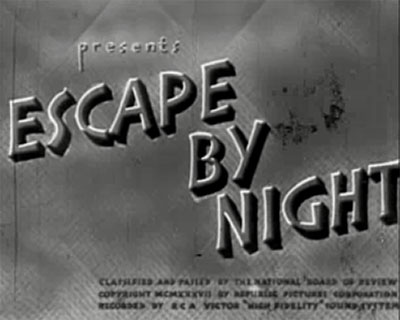
Escape By Night (1937)

3/5 (1)

“Escape by Night” is a 1937 American crime drama film directed by Hamilton MacFadden. The movie stars William Hall, Anne Nagel, and Dean Jagger.

The story revolves around a gang of bank robbers who plan to rob a bank in a small town. The robbers manage to escape with the loot but are pursued by the police. One of the robbers, Steve (William Hall), is separated from his accomplices and ends up taking refuge in a farmhouse, where he meets and falls in love with Jean (Anne Nagel), the farmer’s daughter. Jean initially doesn’t know that Steve is a criminal but eventually discovers his true identity. Steve, meanwhile, is torn between his love for Jean and his loyalty to his fellow robbers.

As the police close in on the robbers, Steve must make a choice between escaping with the loot and leaving Jean behind or staying with Jean and risking capture. The climax of the movie takes place during a violent shootout between the robbers and the police.

Overall, “Escape by Night” is a tense and suspenseful film that explores the themes of love, loyalty, and betrayal. The film has been praised for its strong performances and well-crafted storyline.

Directors:
Hamilton MacFadden

Writer:
Harold Shumate

Stars:
William Hall, Anne Nagel, Dean Jagger

Rate this Movie

Kid Monk Baroni (1952)

3/5 (1)

“Kid Monk Baroni” is a drama film released in 1952. The film is directed by Harold D. Schuster and stars Leonard Nimoy (in his first credited role), Richard Rober, and Bruce Cabot.

The movie follows the story of Leonard “Kid Monk” Baroni (Leonard Nimoy), a young man with a deformed face who is bullied and rejected by his peers. Despite his challenges, Kid Monk is determined to make something of himself and become a successful boxer.

Kid Monk trains hard and eventually catches the eye of boxing promoter Quinn (Richard Rober), who sees potential in the young fighter. Quinn arranges for Kid Monk to have a series of fights, and he quickly rises through the ranks of the boxing world.

As Kid Monk’s fame and success grow, he becomes more and more conflicted about his past and his desire for revenge against those who bullied him. He begins to distance himself from his old friends and becomes more focused on his career.

However, when Kid Monk is challenged to a fight by a former bully, he is forced to confront his past and decide what kind of man he wants to be. In a dramatic final fight, Kid Monk faces his biggest challenge yet and emerges victorious.

In the end, Kid Monk realizes that success in the boxing ring is not enough to bring him true happiness. He decides to leave the world of boxing behind and start a new life, where he can focus on being true to himself and those he cares about.

Directors:
Harold D. Schuster

Writer:
Aben Kandel, Dick Conway

Stars:
Richard Rober, Bruce Cabot, Allene Roberts

Rate this Movie

Night Nurse (1931)

4/5 (1)

“Night Nurse” is a pre-code Hollywood film released in 1931. The film is directed by William A. Wellman and stars Barbara Stanwyck, Clark Gable, and Joan Blondell.

The story follows Lora Hart (Barbara Stanwyck), a nurse who takes on a new job as a night nurse for two young girls, who are being cared for by their wealthy but neglectful mother (Charlotte Merriam) and their alcoholic father (Ben Lyon). Lora quickly realizes that the children’s health is in danger due to their father’s heavy drinking and the neglect of their mother, who is more interested in partying than caring for her children.

With the help of her friend and fellow nurse Maloney (Joan Blondell) and a young ambulance driver named Nick (Clark Gable), Lora tries to protect the children and expose the neglect and abuse they are suffering. However, their efforts are met with resistance from the family’s lawyer and a corrupt doctor who are determined to keep the truth hidden.

As Lora fights to save the children, she also finds herself falling for Nick, but their relationship is complicated by his criminal past and the danger it poses to her and the children.

The film is notable for its portrayal of social issues such as child neglect and corruption, as well as its strong female lead and frank depiction of sexuality and violence. It was also one of the first films to feature the pairing of Barbara Stanwyck and Clark Gable, who would go on to become two of Hollywood’s biggest stars.

Directors:
William A. Wellman

Writer:
Grace Perkins, Oliver H.P. Garrett, Charles Kenyon

Stars:
Barbara Stanwyck, Ben Lyon, Joan Blondell

Rate this Movie

Aerial Gunner (1943)

3/5 (1)

“Aerial Gunner” is a World War II film released in 1943, directed by William H. Pine and starring Richard Arlen and Chester Morris. The film tells the story of a group of aerial gunners who are sent on a mission to bomb a Japanese base in the Philippines.

The film begins with the introduction of the main character, Sergeant Johnny Cates (played by Richard Arlen), who is a veteran aerial gunner. Cates is assigned to a new crew, led by Captain Jeff Young (played by Chester Morris), and together they embark on a dangerous mission to bomb a Japanese base in the Philippines.

As they make their way to the base, the crew encounters various challenges, including enemy fire and mechanical difficulties. Despite these obstacles, they manage to successfully drop their bombs and return to their base.

However, the crew soon discovers that their mission was not as successful as they had thought, and they must return to the Philippines to finish the job. This time, they face even greater challenges, including a Japanese fighter pilot who is determined to take them down.

In the end, the crew manages to complete their mission and return safely to their base. The film ends with Cates and his crew receiving praise for their bravery and skill, and with a message of hope for victory in the war.

Directors:
William H. Pine

Writer:
Maxwell Shane, Jack F. Dailey

Stars:
Richard Arlen, Chester Morris, Amelita Ward

Rate this Movie

Texas to Bataan (1942)

3/5 (1)

“Texas to Bataan” is a war drama film released in 1942, directed by Robert Emmett Tansey and starring John ‘Dusty’ King, Dave O’Brien, and Marjorie Reynolds.

The film tells the story of a group of Texas National Guard soldiers who are called to duty and sent to the Philippines to fight the Japanese during World War II. The soldiers, led by Captain Bill Marshall (John ‘Dusty’ King), are ill-prepared for the harsh realities of combat, but they soon learn to rely on each other for survival.

Once in the Philippines, the soldiers are met with a brutal enemy and a harsh environment. They struggle with hunger, thirst, and disease as they fight to defend their country and hold their ground against the Japanese.

As the war rages on, the soldiers are pushed to their limits, and their bravery and perseverance are put to the test. Along the way, they form deep bonds of brotherhood and camaraderie that sustain them through the toughest of times.

“Texas to Bataan” was made in the midst of World War II and served as a tribute to the bravery and sacrifice of the soldiers who fought in the conflict. The film is an inspiring story of resilience and courage in the face of overwhelming adversity, and it remains a testament to the heroism of those who served their country during one of its darkest hours.

Directors:
Robert Emmett Tansey

Writer:
Arthur Hoerl

Stars:
John ‘Dusty’ King, David Sharpe, Max Terhune

Rate this Movie

Fire Over England (1937)

3/5 (1)

“Fire Over England” is a historical drama film released in 1937, directed by William K. Howard and starring Laurence Olivier, Vivien Leigh, and Flora Robson.

The movie takes place in 1588 England, during the reign of Queen Elizabeth I (Flora Robson). England is facing a dangerous threat from the Spanish Armada, a powerful fleet sent by King Philip II of Spain to conquer England and restore Catholicism.

In the midst of this crisis, Michael Ingolby (Laurence Olivier), a young nobleman in love with the queen’s ward Cynthia (Vivien Leigh), is sent on a mission to uncover a Spanish plot against England. Michael’s investigation leads him to the Spanish ambassador, Count de Paz (Henry Daniell), and his accomplice, the traitorous Lord Wolfingham (Raymond Massey).

As tensions rise and war looms, Queen Elizabeth must decide whether to trust Michael and his information or to rely on the counsel of her advisers. With the fate of England hanging in the balance, Michael and Cynthia must navigate the treacherous political landscape and their own personal desires to ensure England’s safety.

The film received critical acclaim for its performances, costumes, and set design. It was also notable for featuring the real-life lovers Olivier and Leigh in their first on-screen collaboration. “Fire Over England” remains a classic example of historical drama and a significant milestone in the careers of its lead actors.

Directors:
William K. Howard

Writer:
A.E.W. Mason, Clemence Dane, Sergei Nolbandov

Stars:
Laurence Olivier, Flora Robson, Vivien Leigh

Rate this Movie

Becky Sharp (1935)

3/5 (1)

“Becky Sharp” is a 1935 British film directed by Rouben Mamoulian and starring Miriam Hopkins, Frances Dee, and Cedric Hardwicke. The movie is based on the novel “Vanity Fair” by William Makepeace Thackeray, which tells the story of a poor girl named Becky Sharp who tries to climb the social ladder by any means necessary.

The movie follows Becky Sharp, a young woman who lives in a society where money and status are the keys to success. She is determined to rise above her humble origins and become a member of the wealthy elite. Becky’s first opportunity comes when she is hired as a governess for Sir Pitt Crawley’s children. While working for Sir Pitt, Becky meets his two sons, Rawdon and Pitt Jr., and quickly sets her sights on Rawdon, a handsome but poor military officer.

Becky and Rawdon elope, but their marriage is not accepted by Rawdon’s family. Despite this setback, Becky continues to pursue her dreams of wealth and status. She becomes the mistress of the wealthy Marquess of Steyne, who provides her with everything she desires. However, her association with the Marquess leads to her downfall when he dies suddenly, leaving her with nothing.

In the end, Becky is left with nothing but her beauty and charm, but she refuses to give up. She uses her wits and cunning to start over again, determined to succeed at any cost. The movie ends with Becky walking off into the sunset, ready to take on whatever challenges lie ahead.

Overall, “Becky Sharp” is a captivating and entertaining movie that showcases the talents of its cast and director. It explores the themes of ambition, social climbing, and the corrupting influence of wealth and power.

Directors:
Rouben Mamoulian

Writer:
William Makepeace Thackeray, Francis Edward Faragoh, Langdon Mitchell

Stars:
Miriam Hopkins, Frances Dee, Cedric Hardwicke

Rate this Movie

In Which We Serve (1942)

4/5 (1)

“In Which We Serve” is a British wartime drama film released in 1942. It was directed by Noël Coward and David Lean and starred Noël Coward himself, along with John Mills, Bernard Miles, and Celia Johnson. The film tells the story of the crew of HMS Torrin, a British destroyer that is sunk during the Battle of Crete in 1941.

The film opens with the sinking of the Torrin, and then flashes back to tell the story of the ship and her crew. The ship is commanded by Captain Edward Kinross (Noël Coward), who is a strict but fair leader. The crew includes Ordinary Seaman “Shorty” Blake (John Mills), Seaman Freda Lewis (Celia Johnson), and Stoker Petty Officer “Ali” Hakim (Bernard Miles), among others.

Through a series of flashbacks, we see the crew members’ personal lives and how they came to be on the Torrin. We see the ship’s training exercises and its deployment to the Mediterranean, where it participates in the Battle of Crete. During the battle, the Torrin is hit by a bomb and sinks, but the surviving crew members are rescued.

The film ends with the crew back on shore, reflecting on their experiences and their comrades who did not make it back. In the final scene, Captain Kinross addresses the families of the fallen crew members, telling them that their loved ones “died in a service they loved and understood.”

The film was a critical and commercial success and was nominated for several Academy Awards. It is widely considered a classic of British cinema and is noted for its patriotic message and portrayal of the courage and sacrifice of the British Navy during World War II.

Directors:
Noël Coward, David Lean

Writer:
Noël Coward

Stars:
Noël Coward, John Mills, Bernard Miles

Rate this Movie