Drama

Night Train To Munich (1940)

4/5 (1)

“Night Train to Munich” is a 1940 British thriller directed by Carol Reed and starring Margaret Lockwood, Rex Harrison, and Paul Henreid. The movie tells the story of a British secret agent who goes undercover in Nazi Germany to rescue a Czech scientist and his daughter.

The film begins with the Nazi invasion of Czechoslovakia in 1938. The Czech scientist Axel Bomasch (played by James Harcourt) is captured and taken to Germany to work on a top-secret weapon for the Nazis. His daughter, Anna (played by Lockwood), is also taken into custody, but manages to escape to England with the help of a British secret agent, Gus Bennett (played by Harrison).

When the Nazis learn that Anna has escaped, they send their top agent, Captain Axel von Aschenbach (played by Henreid), to track her down. Gus and Anna are forced to go undercover and travel to Germany on the titular “Night Train to Munich” in order to rescue her father.

Once in Germany, Gus and Anna are aided by a variety of characters, including a sympathetic Gestapo agent and a resourceful cabaret singer. However, they are also pursued by Captain von Aschenbach and must use all of their wits and resources to evade capture.

“Night Train to Munich” is a tense and suspenseful film that explores themes of patriotism, sacrifice, and bravery in the face of danger. The movie’s strong performances and intricate plot twists keep viewers on the edge of their seats, while its message of hope and perseverance is both inspiring and uplifting.

Directors:
Carol Reed

Writer:
Gordon Wellesley, Sidney Gilliat, Frank Launder

Stars:
Margaret Lockwood, Rex Harrison, Paul Henreid
Rate this Movie

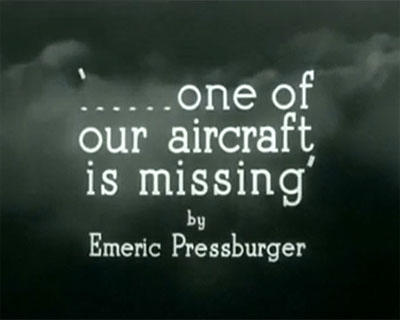
One of Our Aircraft Is Missing (1942)

4/5 (1)

“One of Our Aircraft Is Missing” is a 1942 British war film directed by Michael Powell and Emeric Pressburger, and starring Godfrey Tearle, Eric Portman, and Hugh Williams. The movie tells the story of a bomber crew whose plane is shot down over the Netherlands during a bombing mission over Germany in World War II.

The film begins with the crew taking off on their mission, but their plane is hit by enemy fire and they are forced to bail out. The crew members are scattered across the Dutch countryside and must work together to evade capture by the Germans and make their way back to safety in England.

The movie portrays the bravery and determination of the Dutch resistance fighters who help the British airmen, risking their own lives to shelter them from the Nazis. The airmen must navigate the unfamiliar terrain and face numerous obstacles along the way, including a German patrol and a treacherous river crossing.

As they make their way through enemy territory, the airmen must rely on their training and the kindness of strangers to survive. They also learn important lessons about courage, sacrifice, and the value of teamwork.

“One of Our Aircraft Is Missing” is a powerful and suspenseful film that celebrates the bravery and resilience of ordinary people in times of war. The movie’s message is that, despite the hardships and dangers of war, people can work together to overcome adversity and emerge victorious.

Directors:
Michael Powell, Emeric Pressburger

Writer:
Emeric Pressburger, Michael Powell

Stars:
Godfrey Tearle, Eric Portman, Hugh Williams

Rate this Movie

The Small Back Room (1949)

4/5 (1)

“The Small Back Room” is a 1949 British war film directed by Michael Powell and Emeric Pressburger, and starring David Farrar and Kathleen Byron. The movie tells the story of Sammy Rice, a scientist who is tasked with developing a new type of explosive for the British Army during World War II.

Sammy Rice, played by Farrar, is a talented scientist who suffers from a physical disability and a dependence on alcohol. He is in a turbulent relationship with his girlfriend Susan (played by Byron), who is also struggling with her own personal demons.

Despite his personal struggles, Sammy is determined to complete his work for the Army. He faces a number of challenges, including pressure from his superiors and a series of dangerous accidents in the laboratory. Sammy also becomes embroiled in a tense game of cat and mouse with a German spy who is attempting to steal his research.

As Sammy’s mental and emotional state begins to unravel, he becomes increasingly reliant on Susan for support. However, their relationship is strained as they struggle to come to terms with their own personal demons.

“The Small Back Room” is a character-driven film that explores the psychological toll of war and the impact it can have on individuals. The movie is notable for its use of innovative camera techniques and its portrayal of Sammy’s struggle with disability and addiction. The film’s themes of sacrifice, duty, and personal redemption are timeless and continue to resonate with audiences today.

Directors:
Michael Powell, Emeric Pressburger

Writer:
Nigel Balchi, Michael Powell, Emeric Pressburger

Stars:
David Farrar, Jack Hawkins, Kathleen Byron

Rate this Movie

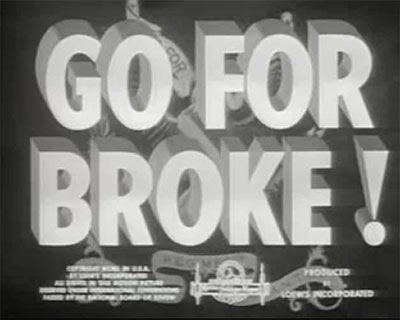
Go for Broke! (1951)

3/5 (1)

“Go for Broke!” is a 1951 war film directed by Robert Pirosh and starring Van Johnson, who plays the role of Lt. Michael Grayson. The movie tells the story of the 442nd Infantry Regiment, a segregated unit of Japanese-American soldiers who fought for the United States during World War II.

The movie follows Lt. Grayson as he is assigned to lead the 442nd Infantry Regiment, made up entirely of Japanese-American soldiers. Despite initial skepticism from his superiors, Lt. Grayson quickly learns to respect and admire the soldiers under his command.

The soldiers of the 442nd face discrimination both at home and on the battlefield. They are initially treated with suspicion and mistrust by their fellow soldiers and face prejudice from civilians back home. However, they remain committed to their mission and determined to prove their loyalty to the United States.

As the war progresses, the soldiers of the 442nd face intense combat in Italy. They are tasked with some of the most dangerous and difficult missions of the war, including a mission to rescue a lost battalion of American soldiers. The soldiers of the 442nd prove their bravery and determination in the face of overwhelming odds.

The movie’s title, “Go for Broke,” is a phrase that was commonly used by the soldiers of the 442nd, meaning to give it your all, to risk everything, to leave nothing on the table. The movie is a tribute to the soldiers of the 442nd Infantry Regiment and their remarkable achievements despite facing discrimination and prejudice.

“Go for Broke” is considered a landmark film for its portrayal of Japanese-American soldiers and its message of tolerance and inclusion. It was one of the first Hollywood films to feature Asian-American actors in lead roles and helped to raise awareness of the contributions and sacrifices of Japanese-Americans during World War II.

Directors:
Robert Pirosh

Writer:
Robert Pirosh

Stars:
Van Johnson, Lane Nakano, George Miki

Rate this Movie

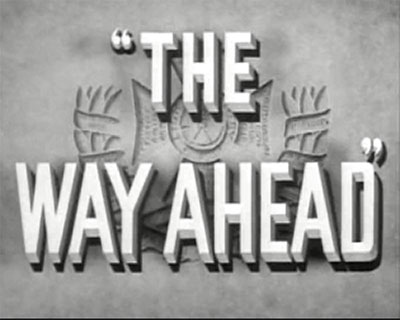
The Way Ahead (1944)

4/5 (1)

“The Way Ahead” is a 1944 British war film directed by Carol Reed and starring David Niven, Stanley Holloway, and William Hartnell. The movie tells the story of a group of civilians who are recruited to join the British Army during World War II and their journey from basic training to the front lines.

The movie begins with a group of mismatched and untrained civilians who are drafted into the Army. They are unsure of what lies ahead and struggle to adjust to military life. However, with the guidance of their tough but fair sergeant (played by Niven), they begin to learn the skills and discipline necessary to become soldiers.

As they progress through training, the soldiers begin to form bonds of camaraderie and mutual respect. They face challenges such as physical training, weapon drills, and live-fire exercises, but they also learn important lessons about leadership, teamwork, and sacrifice.

Eventually, the soldiers are deployed to North Africa, where they face their first taste of combat against the German Army. They must rely on their training and each other to survive and complete their mission.

“The Way Ahead” is a patriotic and uplifting film that celebrates the bravery and sacrifice of ordinary people in times of war. It was made with the support of the British Army and was intended to boost morale during the difficult years of the war. The movie’s message is that everyone has a part to play in the war effort and that by working together, people can achieve great things.

Directors:
Carol Reed

Writer:
Eric Ambler, Peter Ustinov

Stars:
David Niven, Stanley Holloway, James Donald

Rate this Movie

49th Parallel-The Invaders (1941)

4/5 (1)

“49th Parallel” is a 1941 war drama directed by Michael Powell and starring Leslie Howard, Laurence Olivier, and Raymond Massey. The movie tells the story of a group of German sailors who become stranded in Canada during World War II.

The sailors are on a mission to gather intelligence and establish a base for the German invasion of North America. However, their plans are thwarted when their U-boat is sunk by the Royal Canadian Air Force. The surviving crew members must now make their way across Canada, avoiding detection by the authorities.

As they travel through Canada, the sailors encounter a variety of characters, including a French-Canadian trapper (played by Olivier), a pacifist writer (played by Howard), and a group of Hutterites (played by Massey and others). These encounters force the sailors to confront their beliefs and assumptions about the world.

The sailors’ journey becomes increasingly desperate as they are pursued by the Royal Canadian Mounted Police. They resort to violence and theft to survive, leading to tragic consequences for some of the people they encounter.

In the end, the sailors are brought to justice and forced to confront the consequences of their actions. The movie ends with a message of hope and unity, as the characters from different backgrounds come together to fight against the common enemy of fascism.

“49th Parallel” is notable for its anti-fascist message and its portrayal of Canada as a diverse and multicultural society. The movie was nominated for several Academy Awards, including Best Picture, and is considered a classic of British cinema.

Directors:
Michael Powell

Writer:
Emeric Pressburger, Rodney Ackland

Stars:
Leslie Howard, Laurence Olivier, Raymond Massey

Rate this Movie

The Mad Monster (1942)

3/5 (1)

“The Mad Monster” is a horror movie from 1942 directed by Sam Newfield. The movie follows the story of a mad scientist named Dr. Lorenzo Cameron (played by George Zucco) who has developed a serum that can turn animals into monsters.

Dr. Cameron uses his serum to transform his loyal servant Petro (played by Glenn Strange) into a werewolf-like creature that he plans to use as a weapon against his enemies. However, Petro’s transformation is unstable and he becomes increasingly violent and uncontrollable.

Meanwhile, Dr. Cameron’s daughter Lenora (played by Anne Nagel) becomes suspicious of her father’s experiments and teams up with a reporter named Tom Gregory (played by Johnny Downs) to investigate.

The film explores themes of science and the consequences of playing with nature. The special effects and production values are typical of low-budget horror films of the era, but the film has gained a cult following for its campy charm and entertaining storyline.

In the end, Tom and Lenora are able to stop Dr. Cameron’s plans and destroy the serum, but not before Petro wreaks havoc on the town. The film concludes with a warning about the dangers of unchecked scientific experimentation and the importance of ethical boundaries.

Directors:
Sam Newfield

Writer:
Fred Myton

Stars:
Johnny Downs, George Zucco, Anne Nagel

Rate this Movie

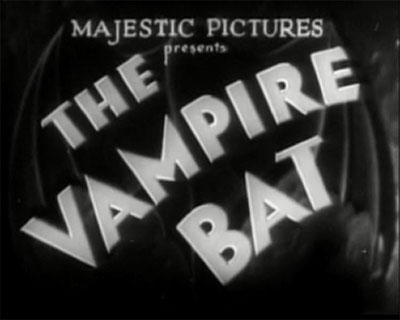
The Vampire Bat (1933)

3/5 (1)

“The Vampire Bat” is a horror movie released in 1933, directed by Frank R. Strayer and starring Lionel Atwill, Fay Wray, and Melvyn Douglas. The movie takes place in a small German village called Kleinschloss, where a string of gruesome murders have been happening, with the victims having their throats bitten and drained of blood. The townspeople believe that a vampire is responsible for the killings and suspect a mysterious and reclusive man, Dr. Otto von Niemann (Atwill).

Inspector Karl Brettschneider (Douglas) is brought in to investigate the murders, along with his assistant, Kringen (Dwight Frye). They soon discover that the real culprit is not a supernatural creature but a deranged human who has been using bat blood to mimic the effects of vampirism. However, before they can catch the killer, several more murders occur, and the townspeople become increasingly panicked.

Meanwhile, the local doctor, Dr. von Niemann, has been conducting strange experiments in his laboratory, leading many to suspect him even further. The inspector and his team eventually discover that von Niemann is not the murderer but has been working to create a serum that can control bats. The real killer is revealed to be Herman (John Wray), a mentally ill man who works as a janitor and has been using the serum to control the bats and carry out his killings.

In the end, Herman is caught, and Dr. von Niemann’s serum is destroyed. The town is finally at peace, and the inspector and his assistant leave Kleinschloss, relieved that the vampire legend has been put to rest.

Directors:
Frank R. Strayer

Writer:
Edward T. Lowe Jr.

Stars:
Lionel Atwill, Fay Wray, Melvyn Douglas

Rate this Movie

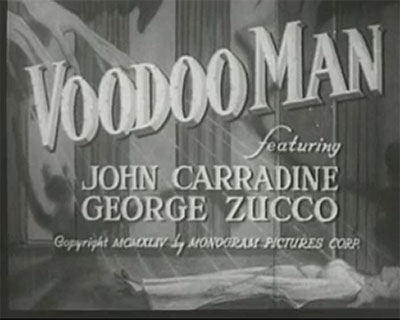
Voodoo Man (1944)

4/5 (2)

“Voodoo Man” is a horror film released in 1944, directed by William Beaudine and produced by Sam Katzman. The film features a cast of horror icons, including Bela Lugosi, George Zucco, and John Carradine.

The story revolves around Dr. Richard Marlowe (Bela Lugosi), a mad scientist who practices voodoo in an attempt to resurrect his deceased wife, who he believes has been reincarnated in the form of a young woman named Angela (Wanda McKay). To achieve his goal, Marlowe kidnaps young women and uses them as sacrifices in his voodoo rituals.

Meanwhile, a group of travelers, including Betty (Louise Currie) and her fiancé Ted (Michael Ames), become stranded near Marlowe’s estate and are taken in by Angela. As they become more involved in the strange events around them, they begin to suspect that something sinister is happening at the estate.

As Marlowe’s experiments become increasingly dangerous, the travelers and Angela work together to try to stop him and his nefarious plans. Along the way, they encounter strange occurrences and supernatural forces, leading to a final confrontation between Marlowe and the group.

The film’s campy and over-the-top performances, combined with its mix of horror and comedy, have made it a cult classic among horror fans. Despite its flaws, “Voodoo Man” remains a fun and entertaining example of 1940s horror cinema.

Directors:
William Beaudine

Writer:
Robert Charles

Stars:
Bela Lugos, John Carradine, George Zucco

Rate this Movie

Dr. Jekyll and Mr. Hyde (1920)

4/5 (1)

“Dr. Jekyll and Mr. Hyde” is a silent film adaptation of Robert Louis Stevenson’s classic novel of the same name. The film was directed by John S. Robertson and stars John Barrymore in the dual roles of Dr. Henry Jekyll and Mr. Edward Hyde.

The story follows Dr. Jekyll, a respected scientist who is working on a potion that can separate a person’s good and evil tendencies. Despite warnings from his friends and colleagues, Jekyll drinks the potion and transforms into the monstrous Mr. Hyde, a brutal and violent man who indulges in his darkest desires.

As Jekyll becomes more and more addicted to the sensation of transforming into Hyde, he loses control over his transformation and begins to fear that he may never be able to return to his original self. Meanwhile, Hyde’s actions become increasingly reckless and dangerous, putting Jekyll’s reputation and relationships at risk.

In the end, Jekyll’s attempts to separate his good and evil selves prove to be a fatal mistake, as he is unable to control his transformations and ultimately destroys himself. The film serves as a cautionary tale about the dangers of giving into one’s darker impulses and the importance of maintaining a sense of balance and control in one’s life.

Directors:
John S. Robertson

Writer:
Robert Louis Stevenson, Clara Beranger, Thomas Russell Sullivan

Stars:
John Barrymore, Martha Mansfield, Brandon Hurst

Rate this Movie

Woman on the Run (1950)

4.33/5 (3)

“Woman on the Run” is a film noir directed by Norman Foster and released in 1950. The film tells the story of a manhunt for a witness in a murder case, who goes on the run after she learns that she is the killer’s next target.

The film begins with a murder in San Francisco, where a man is gunned down in the street. The killer, who is a member of a notorious gang, is caught by the police, but the only witness to the crime, the victim’s estranged wife, Eleanor Johnson (played by Ann Sheridan), goes missing.

The police enlist the help of Eleanor’s husband, Frank (played by Ross Elliott), to help track her down. Frank, who has been living apart from his wife, hires a private detective, Dan Leggett (played by Dennis O’Keefe), to find her. But as Leggett begins to unravel the mystery, he realizes that there is more to the case than meets the eye.

As Leggett gets closer to the truth, he becomes the target of the killer, and he and Eleanor must work together to survive and clear her name.

“Woman on the Run” is a taut and suspenseful film noir that explores themes of betrayal, loyalty, and the search for truth. It features a standout performance by Ann Sheridan as the strong-willed and determined Eleanor, and Dennis O’Keefe as the tough and savvy detective, Dan Leggett. The film is notable for its stunning location shots of San Francisco and its use of real-life locations to create a gritty and realistic atmosphere. It is widely regarded as one of the most underrated films of the film noir genre.

Directors:
Norman Foster

Writer:
Alan Campbell, Norman Foster, Sylvia Tate

Stars:
Stars
Ann Sheridan, Dennis O’Keefe, Robert Keith

Rate this Movie

Waterfront (1944)

3/5 (1)

“Waterfront” is a crime drama film directed by Elia Kazan and released in 1954. The film is set in the gritty world of the New York City docks and follows the story of a young dockworker, Terry Malloy, who becomes embroiled in a web of corruption and violence.

Terry is a former boxer who works as a “longshoreman” on the waterfront. He is recruited by his brother, Charley, who is involved in a corrupt union led by the powerful Johnny Friendly. Terry unwittingly becomes involved in a murder plot orchestrated by Friendly, and begins to question his loyalty to his brother and the union.

As Terry falls in love with the sister of the murdered man and befriends a crusading priest who is trying to expose the corruption on the waterfront, he must choose between his loyalty to his brother and his desire for justice and redemption.

“Waterfront” is a powerful and gripping film that explores themes of loyalty, corruption, and redemption. It features stunning performances by Marlon Brando as Terry Malloy, Karl Malden as Father Barry, and Lee J. Cobb as Johnny Friendly. The film is notable for its realistic portrayal of the gritty world of the New York City docks and its searing indictment of corruption and violence. It has become a classic of American cinema and is widely regarded as one of the greatest films ever made.

Directors:
Steve Sekely

Writer:
Martin Mooney, Irwin Franklyn

Stars:
John Carradine, J. Carrol Naish, Maris Wrixon

Rate this Movie

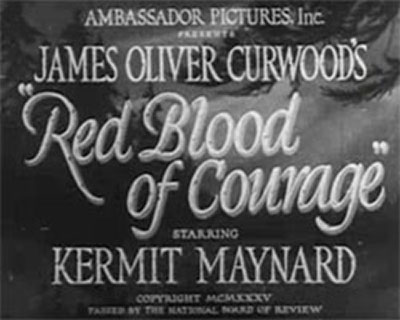
The Red Blood of Courage (1935)

3/5 (1)

“The Red Blood of Courage” is a historical fiction novel written by American author Stephen Crane, first published in 1935. The novel is set during the American Civil War and tells the story of Henry Fleming, a young soldier in the Union Army.

Henry is initially filled with idealistic notions of glory and honor in battle, but as he experiences the brutal reality of war, he begins to question his own courage and becomes consumed by fear. He struggles to reconcile his own fears with the bravery he believes is required of him as a soldier.

As the story progresses, Henry faces a series of challenges that test his courage and resilience. He witnesses the death of many of his fellow soldiers, suffers a head injury, and is mistakenly accused of desertion. Through these trials, he ultimately learns the true meaning of courage and discovers the strength to face his fears and fight for his beliefs.

“The Red Blood of Courage” is a powerful exploration of the human condition and the psychological impact of war. Crane’s vivid descriptions of battle scenes and his realistic portrayal of the inner struggles of soldiers make this novel a poignant and enduring work of literature.

Directors:
John English

Writer:
James Oliver Curwood, Barry Barringer

Stars:
Kermit Maynard, Ann Sheridan, Reginald Barlow

Rate this Movie

The Martyrs of the Alamo (1915) The Birth of Texas

3/5 (1)

“The Martyrs of the Alamo” is a silent film released in 1915, which tells the story of the Battle of the Alamo in San Antonio, Texas, during the Texas Revolution. The movie is considered to be one of the earliest examples of the Hollywood epic genre, and it was directed by Christy Cabanne and produced by D.W. Griffith.

The film begins with the arrival of William Travis, Jim Bowie, and Davy Crockett at the Alamo, which was a former mission that had been converted into a fort by the Texian rebels. The three heroes become friends and prepare to defend the fort against the Mexican army led by General Santa Anna.

The Texans are outnumbered and outgunned, but they fight fiercely and hold off the Mexican army for 13 days. During this time, tensions rise within the Alamo as some of the defenders begin to question whether they should continue fighting or surrender. Travis famously draws a line in the sand and asks all those who are willing to stay and fight to cross it. All of the men do, including Crockett and Bowie, who are later killed in battle.

The final battle is depicted in great detail, with the Texans bravely fighting to the last man. The film ends with the Mexican army victorious and the Alamo in ruins. However, the sacrifice of the Texans at the Alamo inspired others to join the fight for Texas independence, and the film ends with a caption that reads, “Their heroic struggle inspired the birth of Texas.”

“The Martyrs of the Alamo” was a critical and commercial success, and it helped establish Hollywood’s reputation for producing epic films. The movie remains a classic and is considered to be an important part of Texas history, as it tells the story of the brave Texans who fought and died for their independence.

Directors:
Christy Cabanne

Writer:
Christy CabanneTheodosia Harris

Stars:
Sam De Grasse, Allan Sears, Walter Long

Rate this Movie

The File On Thelma Jordan (1950)

4/5 (2)

“The File on Thelma Jordan” is a 1950 film noir directed by Robert Siodmak and starring Barbara Stanwyck and Wendell Corey. The film follows the story of Thelma Jordan, a seductive and mysterious woman who becomes entangled in a web of deceit and murder.

Thelma Jordan (played by Stanwyck) is a wealthy woman who seeks the help of Assistant District Attorney Cleve Marshall (played by Corey) when she discovers that her aunt’s estate is being embezzled. However, Cleve is more interested in Thelma than the case, and the two begin an illicit affair.

As the story unfolds, it becomes clear that Thelma is not the innocent victim she first appeared to be. She is actually involved in a criminal scheme and is using Cleve to cover her tracks. When her ex-lover, Tony Laredo, shows up and threatens to expose her, Thelma is forced to take drastic action, leading to a tragic outcome.

Throughout the film, the audience is kept in suspense as the true nature of Thelma’s character is slowly revealed. The film is a classic example of film noir, with its use of shadows, moody lighting, and morally ambiguous characters.

“The File on Thelma Jordan” is a gripping thriller that showcases the talents of its lead actors and director. The film’s complex storyline and unexpected twists and turns keep audiences on the edge of their seats until the very end.

Directors:
Robert Siodmak

Writer:
Marty Holland, Ketti Frings

Stars:
Barbara Stanwyck, Wendell Corey, Paul Kelly

Rate this Movie