admin

The Phantom Carriage (1921)

5/5 (1)

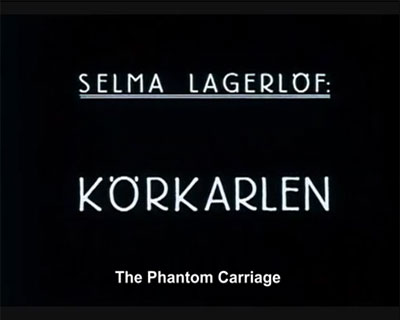
“The Phantom Carriage” is a silent Swedish film directed by Victor Sjöström, released in 1921. The film is based on the novel “Thy Soul Shall Bear Witness!” by Nobel Prize-winning author Selma Lagerlöf. It tells the story of David Holm, a troubled alcoholic who dies on New Year’s Eve and is forced to relive his past through the supernatural power of the phantom carriage.

David Holm is a cruel and abusive man, who has abandoned his wife and children and spends his days drinking and getting into fights. On New Year’s Eve, he is involved in a brawl and is fatally injured. As he dies, he sees the phantom carriage approaching, a vehicle that is said to be driven by Death himself, which collects the souls of the dead.

The driver of the carriage, Georges, informs David that he will be the new driver, and that he will be forced to collect the souls of the dead for the next year. David initially tries to resist, but Georges shows him a vision of his past, revealing the pain and suffering he has caused others throughout his life.

Throughout the night, David is forced to relive his past, including the moment when he abandoned his wife and children, the death of his friend and the consequences of his cruel behavior. He also witnesses the effects of his actions on the lives of those he has hurt, including his wife and a Salvation Army worker named Edit, who tries to save him.

In the end, David realizes the depth of his wrongdoing and begs for forgiveness. He is granted a second chance at life and awakens on New Year’s Day, determined to change his ways and make amends for his past mistakes.

“The Phantom Carriage” is a haunting and powerful film, exploring themes of redemption, forgiveness, and the consequences of one’s actions. Its innovative use of special effects and non-linear storytelling techniques made it a groundbreaking film in its time and has influenced generations of filmmakers since.

Directors:
Victor Sjöström

Writer:
Selma Lagerlöf, Victor Sjöström

Stars:
Victor Sjöström, Hilda Borgström, Tore Svennberg
Rate this Movie

Vampyr (1932)

4/5 (1)

“Vampyr” is a German-French horror film directed by Carl Theodor Dreyer and released in 1932. The movie is loosely based on the novel “Carmilla” by Sheridan Le Fanu, and it follows the story of a young man named Allan Gray who arrives in a small French town and becomes embroiled in a supernatural mystery.

Gray becomes fascinated with the supernatural and begins to explore the town’s eerie surroundings, including an old mill and a nearby castle. He soon discovers that the town is plagued by a group of vampires who are preying on its inhabitants.

Gray finds himself drawn into a strange and terrifying world of the undead, and he must use all of his wits and resources to fight against the creatures of the night. Along the way, he meets a doctor who is also investigating the vampire activity in the town, as well as a young woman who is in danger of becoming the vampires’ next victim.

As Gray delves deeper into the mystery, he realizes that he himself may be in danger from the vampires. In the end, he confronts the vampire leader and manages to destroy her, bringing an end to the town’s nightmare.

The film is known for its dreamlike atmosphere and unique visual style, with Dreyer using innovative techniques such as double exposure to create a sense of otherworldly horror. It has been recognized as a classic of the horror genre and continues to be influential in modern horror filmmaking.

Directors:
Carl Theodor Dreyer

Writer:
Sheridan Le Fanu, Christen Jul, Carl Theodor Dreyer

Stars:
Julian West, Maurice Schutz, Rena Mandel

Rate this Movie

The Testament of Dr. Mabuse (1933)

4/5 (1)

“The Testament of Dr. Mabuse” is a German film directed by Fritz Lang and released in 1933. The movie is a sequel to Lang’s earlier work, “Dr. Mabuse the Gambler,” and it follows the story of a criminal mastermind named Dr. Mabuse who has been institutionalized in an insane asylum.

At the beginning of the film, a group of criminals begins to carry out a series of bizarre crimes that seem to be inspired by Dr. Mabuse’s writings. The police are at a loss to explain the crimes, and it is suggested that Dr. Mabuse may be communicating with the criminals from his asylum.

Meanwhile, a new criminal mastermind, known only as “The Great Unknown,” emerges and begins to carry out his own elaborate schemes. The police begin to suspect that The Great Unknown is somehow connected to Dr. Mabuse and his writings.

As the film progresses, it becomes clear that Dr. Mabuse is indeed communicating with the criminals and that he is behind many of the crimes. He has been using his writings to control and manipulate them from his cell.

In the end, the police manage to capture Dr. Mabuse, but not before he has caused chaos and destruction throughout the city. The film ends with a warning that the forces of evil are still at work and that the struggle between good and evil will continue.

Directors:
Fritz Lang

Writer:
Norbert Jacques, Fritz Lang, René Sti

Stars:
Rudolf Klein-Rogge, Otto Wernicke, Thomy Bourdelle

Rate this Movie

Dracula (1931)

4.5/5 (2)

Dracula is a horror film released in 1931, directed by Tod Browning and starring Bela Lugosi as Count Dracula. The movie is based on the 1897 novel of the same name by Bram Stoker.

The story begins with a young British solicitor named Renfield (Dwight Frye) traveling to Transylvania to meet with a nobleman, Count Dracula. Renfield is warned by the locals about the dangers of visiting the castle, but he persists and ultimately falls under Dracula’s spell.

Dracula then travels to London, where he begins preying on the city’s inhabitants, particularly women. He is eventually discovered by Professor Abraham Van Helsing (Edward Van Sloan), who leads a group of people to hunt him down and stop his reign of terror.

The film is notable for its use of shadow and lighting to create a moody, atmospheric tone, as well as for Lugosi’s iconic performance as Dracula. Despite its age, the film remains a classic of the horror genre and has been cited as a major influence on subsequent vampire movies.

Directors:
Tod Browning, Karl Freund

Writer:
Bram Stoker, Hamilton Deane, John L. Balderston

Stars:
Bela Lugosi, Helen Chandler, David Manners

Rate this Movie

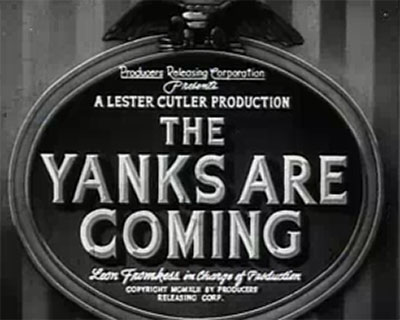
The Yanks Are Coming (1942)

4/5 (2)

“The Yanks Are Coming” is a 1942 American propaganda film directed by Alexis Thurn-Taxis and produced by Warner Bros. The film is a tribute to the American military and its role in World War II. The movie is divided into three parts, each focusing on a different branch of the armed forces.

The first part of the film focuses on the Army, showcasing its training, equipment, and soldiers. It highlights the discipline and dedication of the soldiers as they prepare for war, and it shows the various types of weapons and vehicles they use.

The second part of the film highlights the Navy and its role in protecting the country from invasion. It shows the various types of ships and submarines used by the Navy, as well as the training and skill required to operate them. The film also includes footage of naval battles, including the sinking of German U-boats.

The third and final part of the film is dedicated to the Air Force, which is shown engaging in bombing raids and dogfights with enemy planes. The film highlights the bravery and skill of the pilots, as well as the technological advancements that have made air combat more efficient and deadly.

Throughout the film, the message is clear: the American military is strong, well-equipped, and ready to defend the country against any threat. The film’s title, “The Yanks Are Coming,” is a rallying cry that emphasizes the determination and resolve of the American people to win the war and protect their freedom.

Directors:
Alexis Thurn-Taxis

Writer:
Tony Stern, Lew Pollack, Edward E. Kaye

Stars:
Henry King, Mary Healy, Jack Heller

Rate this Movie

Borrowed Wives (1930)

3/5 (1)

“Borrowed Wives” is a pre-code romantic comedy film released in 1930. The story follows two friends, Dick and Jerry, who both have fiancées but are struggling financially. To solve their financial troubles, they devise a plan to borrow each other’s fiancée in order to seduce a wealthy woman and gain access to her fortune.

However, complications arise when both men fall in love with the woman they are supposed to seduce, and their true identities are eventually revealed. The women are initially upset but eventually forgive their fiancés and the two couples reconcile, with a happy ending for all.

The film was directed by Frank R. Strayer and stars Rex Lease as Dick, Vera Reynolds as Jerry’s fiancée, and Marguerite De La Motte as the wealthy woman they try to seduce. The film is notable for its portrayal of casual infidelity and its frank discussion of sexuality, which was unusual for films of its time.

Directors:
Frank R. Strayer

Writer:
Scott Darling

Stars:
Rex Lease, Vera Reynolds, Paul Hurst

Rate this Movie

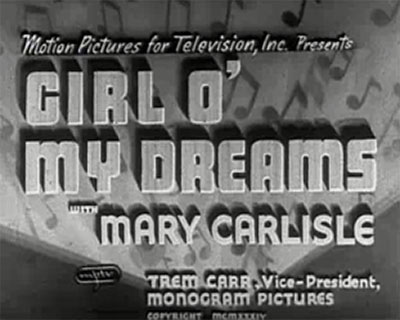
Girl o’ My Dreams (1934)

3/5 (1)

“Girl o’ My Dreams” is a 1934 American romantic musical comedy film directed by Ray McCarey and starring Mary Carlisle, Edward Nugent, Sterling Holloway, and Charles Starrett. The film follows the story of a small-town girl named Sally (Mary Carlisle), who wins a beauty contest and heads to Hollywood to become a movie star. Along the way, she meets and falls in love with a struggling musician named Bob (Edward Nugent).

When Sally arrives in Hollywood, she quickly realizes that the world of movie stardom is not what she expected. She faces a series of disappointments and setbacks, including a sleazy talent agent who tries to exploit her. But through it all, she remains determined to succeed and make a name for herself in the industry.

Meanwhile, Bob is also struggling to make it in the music business. He and his band play gigs at various clubs around town, but they can’t seem to catch a break. When Sally and Bob meet, they immediately hit it off and begin a romance. But their relationship is tested when Sally is offered a movie contract and has to choose between her career and her love for Bob.

In the end, Sally decides to turn down the movie contract and stay with Bob. They both realize that their love for each other is more important than fame and fortune. The film ends with Sally and Bob performing a musical number together, as they set out to make their dreams come true together.

“Girl o’ My Dreams” is a light-hearted and entertaining romantic comedy that captures the glamour and excitement of Hollywood in the 1930s. It showcases the talents of its young stars and features several catchy musical numbers that will keep audiences tapping their toes.

Directors:
Ray McCarey

Writer:
George Waggner

Stars:
Mary Carlisle, Sterling Holloway, Edward J. Nugent

Rate this Movie

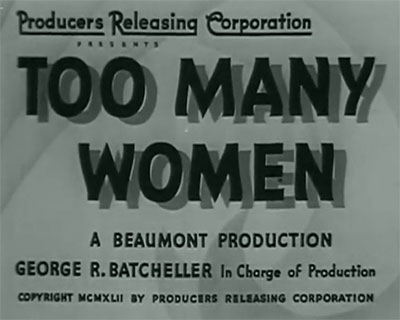
Too Many Women (1942)

3/5 (2)

“Too Many Women” is a 1942 American comedy film directed by Bernard B. Ray and starring Neil Hamilton, June Lang, and Joyce Compton. The film revolves around a detective named Clive Reed (Neil Hamilton) who is hired to investigate the murder of a wealthy businessman. Reed’s investigation leads him to a hotel where he discovers that the victim had been involved with a number of women, all of whom have a motive for the crime.

As Reed interviews the various women, he finds himself drawn to a young woman named Nancy Lee (June Lang), who he believes is innocent of the crime. With Nancy’s help, Reed sets out to solve the case and bring the real killer to justice.

Throughout the film, Reed encounters a number of eccentric characters, including a dim-witted hotel clerk, a manipulative actress, and a nosy reporter. Despite the many obstacles in his way, Reed perseveres in his investigation, and ultimately manages to solve the case and clear Nancy’s name.

Overall, “Too Many Women” is a lighthearted and entertaining film that combines elements of comedy, mystery, and romance. It features a talented cast of actors and a well-crafted plot that keeps the audience guessing until the very end.

Directors:
Bernard B. Ray

Writer:
Eddie Davis

Stars:
Neil Hamilton, June Lang, Joyce Compton

Rate this Movie

The Girl from Calgary (1932)

3/5 (1)

In this 1930 film called “The Girl from Calgary”, a French-Canadian girl named Nona (played by Fifi D’Orsay) is a talented bronc rider and nightclub singer. One evening, an ambitious young man named Duke (played by Monroe Owsley) watches her perform and becomes impressed by her talent. Duke believes that Nona has what it takes to become a star on Broadway and convinces her to accompany him to New York City.

Once they arrive in New York, Nona begins to gain popularity and soon becomes a successful Broadway star. However, Duke realizes that he is being pushed aside by the greedy producers who see Nona as their own personal gold mine. Duke becomes disillusioned with the Broadway scene and decides to leave Nona to pursue his own dreams.

As Nona’s fame and fortune continue to grow, she begins to feel the emptiness of her success without Duke by her side. Eventually, she realizes that she loves Duke and that he was the one who truly believed in her talent from the beginning. In the end, Nona gives up her Broadway career to be with Duke and they both return to Canada to start a new life together.

“The Girl from Calgary” is a romantic drama that explores the themes of ambition, love, and sacrifice in the pursuit of success.

Directors:
Phil Whitman

Writer:
Lee Chadwick, Leon D’Usseau, Sid Schlager

Stars:
Fifi D’Orsay, Paul Kelly, Robert Warwick

Rate this Movie

Chasing Trouble (1940)

3/5 (1)

“Chasing Trouble” is a 1940 comedy film directed by Howard Bretherton and starring Frankie Darro and Marjorie Reynolds.

The movie tells the story of Jimmy Smith (Frankie Darro), a young man who dreams of becoming a detective. However, he is currently working as a dishwasher at a hotel. One day, while washing dishes, Jimmy overhears a group of gangsters plotting to rob the hotel. He immediately alerts the police, but they don’t believe him because of his reputation for telling tall tales.

Determined to prove himself, Jimmy sets out to catch the robbers on his own. He enlists the help of his girlfriend, Peggy (Marjorie Reynolds), and together they follow the gangsters’ trail, which leads them to a deserted warehouse. There, they discover the gang’s hideout and witness the robbers in action.

Jimmy and Peggy manage to escape and go to the police with the evidence they’ve gathered. With the help of the young detective, the police are able to arrest the gangsters and Jimmy finally earns the respect of his peers.

“Chasing Trouble” is a light-hearted and entertaining film that showcases the talents of Frankie Darro and Marjorie Reynolds. The movie features a mix of comedy, action, and suspense, making it an enjoyable watch for fans of classic cinema.

Directors:
Howard Bretherton

Writer:
Mary Eunice McCarthy

Stars:
Frankie Darro, Marjorie Reynolds, Mantan Moreland

Rate this Movie

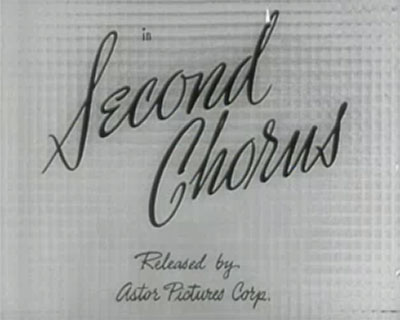
Second Chorus (1940)

3/5 (1)

“Second Chorus” is a musical comedy film directed by H.C. Potter and released in 1940. The movie follows the story of two musicians who are competing for the affections of a young woman while trying to make it big in the music industry.

The film’s protagonists are Danny O’Neill (Fred Astaire) and Hank Taylor (Burgess Meredith), two friends who are both talented musicians. They are both vying for the attention of Ellen Miller (Paulette Goddard), a beautiful and ambitious young woman who wants to become a successful band manager.

As Danny and Hank try to make it big in the music industry, they get mixed up with a group of gangsters who are interested in using their talents for illegal purposes. The two friends must work together to navigate these dangerous situations while also trying to win over Ellen.

Throughout the film, there are several musical performances, including several dance numbers featuring Fred Astaire’s signature moves. The film also features a number of comedic moments, particularly between Danny and Hank, who have a bit of a love-hate relationship.

In the end, Danny and Ellen end up together, and Danny and Hank’s music career takes off. The film ends with the two friends playing a triumphant performance, cementing their success in the music industry.

Overall, “Second Chorus” is a lighthearted musical comedy that showcases the talents of Fred Astaire and Paulette Goddard. The film’s music, dance numbers, and comedic moments make it an enjoyable watch for fans of classic Hollywood cinema.

Directors:
H.C. Potter

Writer:
Frank Cavett, Elaine Ryan, Ian McLellan Hunter

Stars:
Fred Astaire, Paulette Goddard, Artie Shaw

Rate this Movie

Escape to Paradise (1939)

3/5 (1)

“Escape to Paradise” is a romantic drama film directed by Erle C. Kenton and released in 1939. The movie tells the story of a woman who escapes from her dull life and finds love and adventure on a tropical island.

The film’s protagonist is Ellen Graham (Bobby Breen), a young girl who lives a sheltered life with her wealthy family. Feeling stifled by her privileged existence, Ellen decides to run away and seek adventure.

She ends up on a tropical island, where she meets a group of people who are also seeking to escape their pasts. Among them is Tony (Robert Cummings), a handsome musician who falls in love with Ellen.

As Ellen and Tony’s relationship blossoms, they face challenges from the other island residents who disapprove of their romance. Ellen also struggles with the decision to return home to her family or stay on the island with Tony.

In the end, Ellen chooses to stay on the island with Tony and embrace the life of adventure she has found. The film ends with the two of them sailing off into the sunset, happy and in love.

Overall, “Escape to Paradise” is a classic romantic drama that explores the themes of love, adventure, and finding one’s true self. The film features strong performances by Bobby Breen and Robert Cummings and stunning tropical scenery that transports the audience to a far-off paradise.

Directors:
Erle C. Kenton

Writer:
Ian McLellan Hunter, Herbert Clyde Lewis, Weldon Melick

Stars:
Bobby Breen, Kent Taylor, Marla Shelton

Rate this Movie

Midnight Manhunt (1945)

4/5 (2)

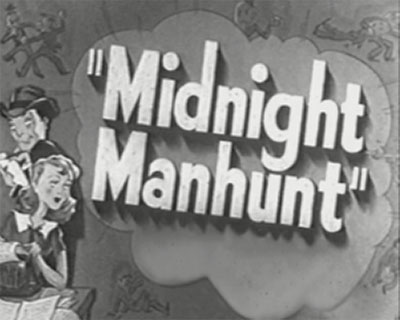
“Midnight Manhunt” is a mystery-thriller film directed by William C. Thomas and released in 1945. The movie follows the story of a manhunt for a killer who is on the loose in a large city.

The film’s protagonist is James A. Brooks (William Gargan), a private detective who is hired to investigate the murder of a famous actor. The police believe that the actor’s assistant, Steve Randall (George Zucco), is the killer and are actively searching for him.

As James investigates the case, he discovers that there may be more to the story than what the police initially believed. He begins to suspect that the killer may be someone else entirely and sets out to uncover the truth.

As the manhunt for Steve Randall intensifies, James races against the clock to solve the case before an innocent man is wrongfully convicted. Along the way, he encounters a cast of suspicious characters, including a shady nightclub owner and a femme fatale.

In the end, James is able to solve the case and catch the real killer, who is revealed to be someone unexpected. The film ends with James triumphant and the city safe once again.

Overall, “Midnight Manhunt” is a classic whodunit-style thriller that keeps the audience guessing until the very end. The film features a strong performance by William Gargan as the determined detective and a cast of memorable characters.

Directors:
William C. Thomas

Writer:
David Lang

Stars:
William Gargan, Ann Savage, Leo Gorcey

Rate this Movie

The Town Went Wild (1944)

4/5 (2)

“The Town Went Wild” is a comedy film directed by Ralph Murphy and released in 1944. The movie is set in a small town that experiences a sudden and bizarre change in behavior among its residents.

The film’s protagonist is Frank Raymond (Freddie Bartholomew), a young man who returns to his hometown after serving in the military during World War II. He finds the town in chaos, with its inhabitants suddenly becoming wild and unruly.

The cause of the town’s transformation is a mysterious gas that has been released from a nearby chemical plant. The gas affects people differently, with some becoming aggressive and others becoming overly emotional.

As the town’s residents become more and more uncontrollable, Frank and his girlfriend, Jane (Joan Leslie), work to find a solution to the problem. They discover that the gas has also affected the town’s water supply and work to cut off the source of contamination.

In the end, Frank and Jane are able to restore order to the town and save it from complete chaos. The film ends with the two of them embracing, happy to have reunited and brought peace back to their community.

Overall, “The Town Went Wild” is a lighthearted comedy that uses the idea of a small town going crazy as a humorous premise. The film also touches on themes of community and the importance of working together to solve problems.

Directors:
Ralph Murphy

Writer:
Bernard B. Roth, Clarence Greene, Russell Rouse

Stars:
Freddie Bartholomew, Jimmy Lydon, Edward Everett Horton

Rate this Movie

King of the Zombies (1941)

3/5 (1)

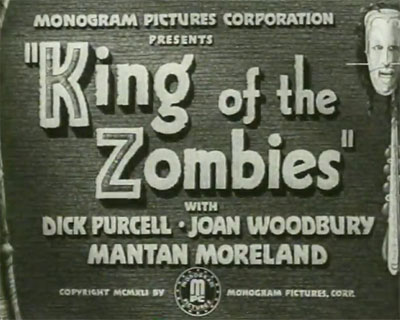
“King of the Zombies” is a horror-comedy film directed by Jean Yarbrough and released in 1941. The movie is set during World War II and follows a group of individuals who become stranded on a remote Caribbean island.

The film’s protagonist is James McCarthy (Dick Purcell), a pilot who, along with his assistant, Bill Summers (Mantan Moreland), and his socialite passenger, Barbara Winslow (Joan Woodbury), crash-lands on the island. They are taken in by Dr. Sangre (Henry Victor), a sinister scientist who is conducting experiments on zombies in his secluded mansion.

Sangre’s assistant, a voodoo priest named Momba (John Archer), is in charge of the zombies, which he uses to do his bidding. Momba hypnotizes Bill, forcing him to do his bidding, and they set out to find a secret formula that Sangre believes will help the Axis powers win the war.

James and Barbara, meanwhile, are locked up in the mansion and try to escape. They discover that the mansion is filled with zombies, which they must fight off to get to safety.

In the end, James and Barbara manage to escape, and Sangre and Momba are killed in a final confrontation with the zombies. James and his companions make their way back to civilization, but not before experiencing several more supernatural and comedic mishaps along the way.

Overall, “King of the Zombies” is a low-budget, campy horror-comedy film that is notable for its portrayal of zombies as mindless, obedient servants rather than the flesh-eating monsters they are commonly known as today.

Directors:
Jean Yarbrough

Writer:
Edmond Kelso

Stars:
Dick Purcell, Joan Woodbury, Mantan Moreland

Rate this Movie