admin

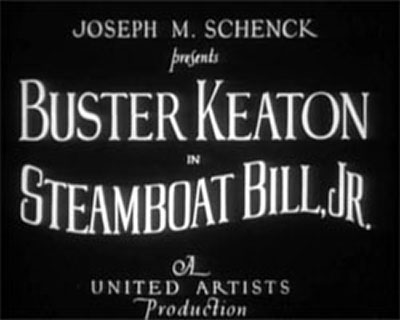
Steamboat Bill, Jr (1928)

4/5 (1)

“Steamboat Bill, Jr.” is a silent comedy film from 1928, directed by Charles Reisner and starring Buster Keaton. The story takes place in a small Mississippi town, where William “Steamboat Bill” Canfield (Ernest Torrence), a gruff and tough riverboat captain, runs a struggling business. He hopes that his son, also named William (Buster Keaton), will come and help him out.

When William Jr. arrives, his father is disappointed to find that he is a weak and effeminate young man who dresses in the latest fashion and plays the ukulele. Despite his father’s disapproval, William Jr. falls in love with Kitty (Marion Byron), the daughter of Steamboat Bill’s rival, the wealthy and successful J.J. King (Tom McGuire).

As a hurricane approaches, the tension between the two families escalates. William Jr. and Kitty get caught in the middle of the chaos, and William Jr. must prove his worth and courage to both his father and Kitty’s father. The film culminates in a thrilling and iconic sequence in which Keaton’s character, caught in the middle of the hurricane, survives by narrowly avoiding a falling building facade, which he passes through a window frame.

Overall, “Steamboat Bill, Jr.” is a classic comedy film that showcases Buster Keaton’s talent for physical humor and his ability to create hilarious and inventive gags. The film is also notable for its impressive stunt work and special effects, which were groundbreaking for their time.

Directors:
Charles Reisner, Buster Keaton

Writer:
Carl Harbaugh

Stars:
Buster Keaton, Tom McGuire, Ernest Torrence

Rate this Movie

Scrooge (1935)

3/5 (1)

“Scrooge” is a 1935 British film directed by Henry Edwards and starring Seymour Hicks as Ebenezer Scrooge. The movie is based on Charles Dickens’ famous novel “A Christmas Carol”.

The story follows the life of the miserly and cold-hearted Ebenezer Scrooge, who despises Christmas and everything associated with it. He runs his business with an iron fist, treating his employees poorly and refusing to donate to charity.

On Christmas Eve, Scrooge is visited by the ghost of his former business partner, Jacob Marley, who warns him that he will suffer the same fate unless he changes his ways. Scrooge is then visited by three ghosts: the Ghost of Christmas Past, the Ghost of Christmas Present, and the Ghost of Christmas Yet to Come.

Through these visits, Scrooge is shown the errors of his ways, the happiness he has missed out on, and the consequences of his current path. He finally realizes the true meaning of Christmas and becomes a changed man, spreading joy and kindness to those around him.

The film was praised for its faithful adaptation of the novel and Seymour Hicks’ performance as Scrooge. It remains a classic Christmas movie to this day.

Directors:
Henry Edwards

Writer:
Charles Dickens, H. Fowler Mear

Stars:
Seymour Hicks, Donald Calthrop, Robert Cochran

Rate this Movie

Rocky Jones, Space Ranger – Crash of the Moons (1954)

3/5 (1)

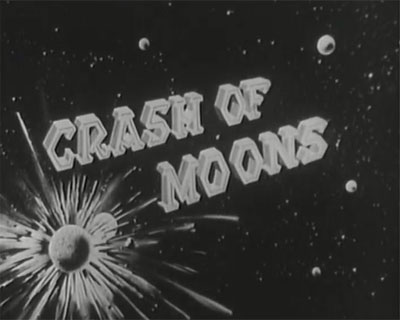
“Crash of the Moons” is a 1954 American science fiction film directed by Hollingsworth Morse and starring Richard Crane, Sally Mansfield, and Robert Lyden. The movie is a feature-length version of the TV series “Rocky Jones, Space Ranger.”

The film opens with Rocky Jones (Richard Crane) and his team traveling to the planet Posedon to help a group of settlers who are experiencing a severe drought. On the way, they encounter a moon named Icena, which is on a collision course with Posedon. The only way to prevent a disaster is to tow Icena away from the planet.

Meanwhile, on Icena, two rival factions are engaged in a power struggle. One group, led by Cleolanta (Patsy Parsons), wants to evacuate the moon and move to Posedon, while the other group, led by Bavarro (Robert Lyden), wants to stay on Icena and exploit its resources. Cleolanta and Bavarro both believe that Rocky Jones and his team are there to help them, and they each try to win Rocky’s support.

As Rocky and his team work to save Posedon from the impending collision, they also become embroiled in the conflict on Icena. Ultimately, Rocky must use his wits and his courage to bring the two factions together and convince them to work toward a common goal.

In the end, Rocky is successful in his mission to tow Icena away from Posedon, and the two factions on Icena join forces to create a new society on the moon. Rocky and his team return home, confident in the knowledge that they have saved countless lives and brought peace to a troubled world.

Directors:
Hollingsworth Morse

Writer:
Warren Wilson

Stars:
Richard Crane, Scotty Beckett, Sally Mansfield

Rate this Movie

Reign of Terror (1949)

4/5 (1)

“Reign of Terror” is a 1949 American film directed by Anthony Mann and starring Robert Cummings, Richard Basehart, and Arlene Dahl. The movie is set during the French Revolution and follows the story of a man named Charles D’Aubigny (Robert Cummings) who is sent to France to retrieve a list of counter-revolutionaries.

The film opens with Maximilien Robespierre (Richard Basehart), the leader of the Committee of Public Safety, executing a fellow revolutionary for being a counter-revolutionary. D’Aubigny, who is working for the French government, arrives in Paris and meets with his contact, Madelon (Arlene Dahl). She reveals to him that the list of counter-revolutionaries has been stolen and is now in the possession of Citizen Fouquet (Arnold Moss).

D’Aubigny sets out to find Fouquet and retrieve the list, but he soon discovers that Robespierre and his allies are using the list to eliminate anyone they suspect of opposing the Revolution. D’Aubigny is forced to go into hiding, but he continues to work with Madelon and other members of the underground resistance to bring down Robespierre.

As the Reign of Terror intensifies, D’Aubigny and his allies must navigate a dangerous web of intrigue and betrayal. They are aided by the enigmatic Madelon, who has her own reasons for opposing Robespierre. Eventually, D’Aubigny is able to obtain the list and use it to bring down Robespierre and his allies.

The film ends with D’Aubigny and Madelon watching as Robespierre is led to the guillotine. They realize that the Revolution has descended into tyranny, but they also know that their work is not yet done. The film closes with a quote from Robespierre: “Terror is only justice prompt, severe and inflexible; it is then an emanation of virtue; it is less a distinct principle than a natural consequence of the general principle of democracy, applied to the most pressing wants of the country.”

Directors:
Anthony Mann

Writer:
Philip Yordan, Æneas MacKenzie

Stars:
Robert Cummings, Richard Basehart, Richard Hart

Rate this Movie

Return of the Scarlet Pimpernel (1937)

3/5 (1)

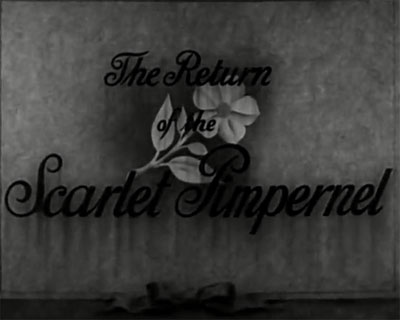
“The Return of the Scarlet Pimpernel” is a 1937 British film directed by Hanns Schwarz and starring Barry K. Barnes, Sophie Stewart, and Margaretta Scott. The movie is a sequel to the 1934 film “The Scarlet Pimpernel,” based on the novel by Baroness Orczy.

The film is set in the aftermath of the French Revolution, and it follows the story of Sir Percy Blakeney (Barry K. Barnes), a British aristocrat who secretly operates as the Scarlet Pimpernel, a heroic figure who rescues French aristocrats from execution. Sir Percy’s wife, Marguerite (Sophie Stewart), is unaware of his secret identity.

When a group of French revolutionaries arrive in England seeking to extradite the exiled Duke of Orleans (James Mason), Sir Percy becomes embroiled in a dangerous game of political intrigue. The revolutionaries are led by Chauvelin (Francis Lister), a former adversary of Sir Percy who is determined to capture him and bring him to justice.

As Sir Percy attempts to thwart Chauvelin’s plans and save the Duke of Orleans, Marguerite becomes suspicious of her husband’s activities and begins to investigate. Meanwhile, Sir Percy’s loyal band of followers, known as the League of the Scarlet Pimpernel, aid him in his mission to protect the Duke and defeat Chauvelin.

In the end, Sir Percy is able to outmaneuver Chauvelin and rescue the Duke, but not before Marguerite discovers his secret identity. The film ends with Sir Percy revealing the truth to his wife and pledging to continue his work as the Scarlet Pimpernel.

Directors:
Hanns Schwarz

Writer:
Baroness Emmuska Orczy, Lajos Biró, Arthur Wimperis

Stars:
Barry K. Barnes, Sophie Stewart, Margaretta Scott

Rate this Movie

Rain (1932)

3/5 (1)

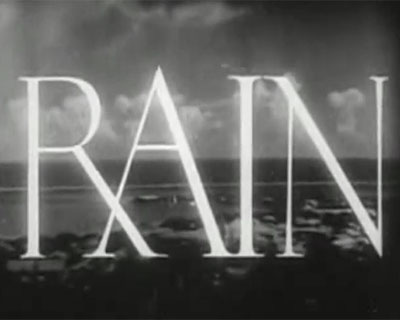
“Rain” is a novel by W. Somerset Maugham, first published in 1921, and later adapted into a play and several film adaptations. The novel is set in the South Pacific, on the island of Tutuila in American Samoa, and follows the story of a group of travelers who become stranded on the island during a torrential rainstorm.

The main character, Charles Davidson, is a Christian missionary who is traveling to the island of Apia to open a church. He becomes stranded on Tutuila with a group of fellow travelers, including Sadie Thompson, a former prostitute who is on her way to Australia to start a new life. Davidson is immediately drawn to Sadie, but his attempts to convert her to Christianity are met with resistance.

As the rain continues to fall, tensions rise among the group. Davidson becomes increasingly obsessed with saving Sadie’s soul, while Sadie becomes more and more disillusioned with his religion. Eventually, Davidson convinces Sadie to come to his church for a service, but her presence causes a scandal among the islanders. In the end, Sadie is forced to leave Tutuila, and Davidson is left alone to contemplate the limits of his own faith.

The novel is notable for its exploration of themes such as religion, morality, and the clash of cultures, and is considered one of Maugham’s most significant works.

Directors:
Lewis Milestone

Writer:
John Colton, Clemence Randolph, W. Somerset Maugham

Stars:
Joan Crawford, Walter Huston, Fred Howard

Rate this Movie

Panic In The Streets (1950)

3/5 (1)

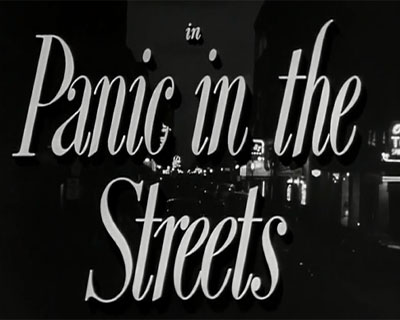
“Panic in the Streets” is a 1950 film noir directed by Elia Kazan. The film is a thriller about a manhunt for a murderer infected with pneumonic plague. The story is set in New Orleans, where a seaman named Ortega is found dead with symptoms of the plague. Dr. Clinton Reed (played by Richard Widmark), a public health official, realizes the danger of an outbreak and tries to convince the authorities to take immediate action to prevent the spread of the disease.

Reed teams up with police captain Tom Warren (played by Paul Douglas) to track down the killer, who is also infected with the plague and could potentially infect others. The manhunt takes them through the dark alleys and seedy underworld of New Orleans, as they search for clues and try to find the killer before he can infect more people.

As they close in on the killer, tensions rise, and the situation becomes more desperate. The clock is ticking as Reed and Warren race against time to find the killer and prevent a deadly epidemic from breaking out.

The film was praised for its realism and suspenseful atmosphere, and it won an Academy Award for Best Original Screenplay. It is considered a classic of the film noir genre and a must-see for fans of suspenseful thrillers.

Directors:
Elia Kazan

Writer:
Richard Murphy, Daniel Fuchs, Edna Anhalt

Stars:
Richard Widmark, Paul Douglas, Barbara Bel Geddes

Rate this Movie

Phantom Thunderbolt (1933)

3/5 (1)

“Phantom Thunderbolt” is a Western film released in 1933, directed by Alan James and starring Ken Maynard, Dorothy Dix, and Tarzan, the horse. The film follows the story of a cowboy named Ken Mitchell (Ken Maynard), who is falsely accused of robbing a stagecoach and killing the driver.

Ken sets out to clear his name and catch the real culprit, the notorious outlaw known as the Phantom Thunderbolt, who has been terrorizing the countryside. Along the way, he meets a beautiful saloon owner named Molly McVey (Dorothy Dix), who offers to help him in his quest for justice.

As Ken and Molly get closer to finding the Phantom Thunderbolt, they face many dangers and obstacles, including a gang of outlaws who are working with the Phantom. In the end, Ken manages to capture the Phantom Thunderbolt and clear his name, with the help of his trusty horse Tarzan and Molly.

The film is notable for its thrilling action sequences, including a dramatic horse chase and a tense shootout, as well as its colorful characters and Old West setting. “Phantom Thunderbolt” remains a classic example of the Western genre and a popular film among fans of classic Hollywood cinema.

Directors:
Alan James

Writer:
Alan James, Forrest Sheldon, Betty Burbridge

Stars:
Ken Maynard, Tarzan, Frances Lee

Rate this Movie

Pride and Prejudice (1940)

3/5 (1)

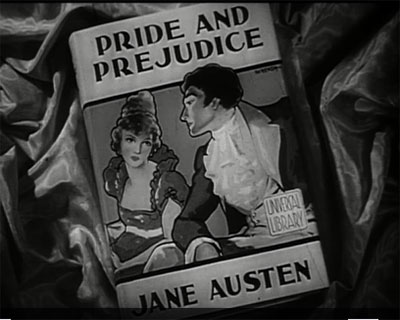
“Pride and Prejudice” is a 1940 romantic drama film directed by Robert Z. Leonard and starring Greer Garson and Laurence Olivier. The film is based on Jane Austen’s classic novel of the same name, published in 1813.

The story is set in rural England during the late 18th century and follows the five Bennett sisters, who are of marriageable age and come from a respectable family, but lack a sizable inheritance. Mrs. Bennett, their mother, is eager to see them all married to wealthy suitors, especially the eldest daughter, Jane.

The story revolves around the romantic relationship between Elizabeth Bennett, the second eldest daughter, and Mr. Darcy, a wealthy and proud gentleman. Despite their initial dislike for each other, they are drawn together as they become more aware of each other’s true character.

Along the way, there are numerous misunderstandings and obstacles to their relationship, including the intervention of Mr. Darcy’s snobbish aunt, Lady Catherine de Bourgh, who disapproves of the match.

The film also features the comedic antics of the Bennett’s eccentric cousin, Mr. Collins, who is intent on marrying one of the Bennett sisters and securing his future inheritance.

In the end, Elizabeth and Mr. Darcy overcome their pride and prejudice to declare their love for each other and embark on a happy future together.

The film was well-received upon its release, with particular praise for Garson’s portrayal of Elizabeth Bennett. It was nominated for four Academy Awards, including Best Picture, and won the Oscar for Best Art Direction.

Directors:
Robert Z. Leonard

Writer:
Aldous Huxley, Jane Murfin, Jane Austen

Stars:
Greer Garson, Laurence Olivier, Mary Boland

Rate this Movie

Princess Iron Fan (Tien Shan Gong Zhu) (1941)

3/5 (1)

Princess Iron Fan (Tien Shan Gong Zhu) is a 1941 Chinese animated film directed by the Wan brothers. It is considered the first feature-length animated film in Chinese history.

The film is based on a popular Chinese folk tale, which tells the story of a group of travelers on a quest to obtain the magical fan of Princess Iron Fan, in order to use it to extinguish flames on a mountain blocking their path. Along the way, they encounter various obstacles and enemies, including the mischievous Monkey King.

The film was a technical achievement for its time, featuring detailed and intricate hand-drawn animation, as well as the use of a multiplane camera to create depth and movement in the backgrounds. The film also features traditional Chinese music and song, which adds to its cultural significance.

Princess Iron Fan was released during a turbulent period in Chinese history, when the country was at war with Japan. The film’s themes of perseverance and overcoming obstacles in the face of adversity resonated with Chinese audiences, and it became a beloved classic of Chinese animation.

Today, Princess Iron Fan is recognized as an important milestone in the history of Chinese animation, and it continues to be celebrated for its cultural and artistic significance.

Directors:
Wan Laiming, Guchan Wan

Writer:
Wang Gan-Bai

Stars:
Guanxiang Liu, Chen Zhengfa, Zhou Jirang

Rate this Movie

October (1927)

3/5 (1)

October (or Oktyabr) is a 1927 silent historical film directed by Sergei Eisenstein, based on the events of the October Revolution in Russia in 1917. The film was commissioned by the Soviet government to commemorate the 10th anniversary of the revolution.

The film depicts the events leading up to and during the October Revolution, including the overthrow of the Provisional Government, the storming of the Winter Palace, and the establishment of Soviet power. The film’s themes emphasize the role of the masses in the revolution and the importance of collective action.

Eisenstein employed his signature montage technique to create a dynamic and dramatic portrayal of the revolution, with striking visual imagery and symbolism. The film features a large ensemble cast, with notable performances by Nikolai Popov as Lenin and Boris Livanov as Trotsky.

October was a significant achievement in the history of Soviet cinema, and it is regarded as a masterpiece of early Soviet filmmaking. Its innovative approach to filmmaking influenced generations of filmmakers around the world, and it remains a landmark in the history of cinema.

Directors:
Grigoriy Aleksandrov, Sergei Eisenstein

Writer:
Sergei Eisenstein, Grigoriy Aleksandrov, John Reed

Stars:
Boris Livanov, Nikolay Popov, Vasili Nikandrov

Rate this Movie

Outside The Law (1921)

3/5 (1)

“Outside the Law” is a silent film released in 1921, directed by Tod Browning, and starring Priscilla Dean, Lon Chaney, and Wheeler Oakman. The film tells the story of a gangster named “Black” Mike Sylva (played by Oakman) and his efforts to recruit a young thief named “Fingers” (played by Dean) to join his criminal organization.

Fingers’ father was a notorious criminal who was killed in a shootout with the police, and she has been raised by her uncle, who is also a thief. When her uncle is caught and sent to prison, Fingers is left alone and vulnerable. Black Mike sees her potential as a skilled pickpocket and offers her a job, but Fingers is initially hesitant to join his gang.

Meanwhile, a police detective named “Silent” Madden (played by Chaney) is hot on Black Mike’s trail and becomes suspicious of Fingers’ involvement with the gang. He befriends her and tries to convince her to help him catch Black Mike and his associates.

As Fingers becomes more involved with the gang, she begins to develop feelings for Black Mike’s right-hand man, “Dapper” Bill Ballard (played by Ralph Lewis). When she discovers that Black Mike plans to double-cross and kill Bill, she decides to help Silent Madden and the police take down the gang.

The film climaxes with a thrilling chase and shootout between the police and the gang, with Fingers and Bill caught in the middle. In the end, justice is served, and Fingers is given a second chance at life, thanks to Silent Madden’s compassion and understanding.

“Outside the Law” was a critical and commercial success upon its release, cementing Lon Chaney’s reputation as a master of character acting and Tod Browning’s status as a skilled director of crime dramas.

Directors:
Tod Browning

Writer:
Gardner Bradford, Tod Browning, Lucien Hubbard

Stars:
Priscilla Dean, Wheeler Oakman, Lon Chaney

Rate this Movie

One Week (1920)

4/5 (1)

“One Week” is a 1920 silent comedy film directed by and starring Buster Keaton, and co-directed by Edward F. Cline. The film follows the story of a newlywed couple, Buster and Sybil (Sybil Seely), who receive a build-it-yourself house as a wedding gift.

Excited to start their new life together, the couple sets out to build the house, but everything goes wrong from the very beginning. They struggle to assemble the house, and the instructions that come with it are confusing and mixed up. As a result, their house ends up being a disaster, with windows and doors in the wrong places and the whole structure tilted at an angle.

As they try to make the best of their new home, they face a series of mishaps and challenges, including a runaway automobile, a lost cow, and a group of thieves who try to steal their home.

Despite all the setbacks, Buster and Sybil remain determined to make their house a home, and they ultimately find a way to turn their disastrous start into a happy ending.

“One Week” is considered a classic of silent comedy and is known for its creative use of physical humor and innovative camera techniques. It was one of Buster Keaton’s earliest and most successful films, helping to establish him as a major star of the silent era.

Directors:
Edward F. Cline, Buster Keaton

Writer:
Edward F. Cline, Buster Keaton

Stars:
Buster Keaton, Sybil Seely, Joe Roberts

Rate this Movie

Nightmare Castle (1965)

3/5 (1)

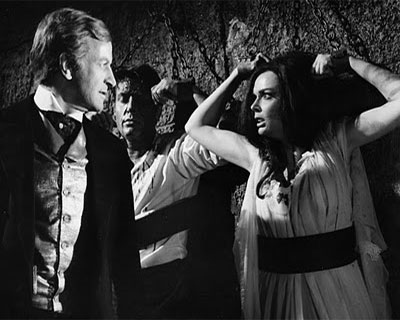
“Nightmare Castle” is a 1965 horror movie directed by Mario Caiano. The movie takes place in an isolated castle in the 19th century, where a wealthy scientist named Stephen Arrowsmith (Paul Muller) lives with his wife Muriel (Barbara Steele) and his mistress Solange (also played by Steele).

The story begins when Stephen discovers that Muriel has been unfaithful to him with his own doctor, and he decides to torture and kill both of them. Before dying, Muriel curses Stephen and Solange, and their souls are doomed to wander the castle forever.

Years later, a young couple, Jenny (Helga Liné) and her husband, arrive at the castle. Jenny has been invited by Stephen to stay there and help with his research. But as soon as they arrive, strange things start to happen. Jenny sees apparitions of Muriel and Solange, and Stephen’s behavior becomes increasingly erratic.

Jenny eventually discovers the truth about what happened to Muriel and Solange and finds herself in danger as she becomes the target of Stephen’s twisted experiments.

In the end, the curse is broken, and justice is served as Stephen meets his demise.

Directors:
Mario Caiano

Writer:
Mario Caiano, Fabio De Agostini

Stars:
Barbara Steele, Paul Muller, Helga Liné

Rate this Movie

No Time For Sergeants (1955)

4/5 (1)

“No Time for Sergeants” is a comedy film released in 1955, directed by Mervyn LeRoy and based on a novel by Mac Hyman. The movie follows the story of Will Stockdale, a good-natured and somewhat naive country boy from Georgia who is drafted into the U.S. Army during the Korean War.

Will’s lack of knowledge and understanding of the military hierarchy and rules creates many humorous situations. He becomes the center of attention in his barracks, as his antics draw the attention of his drill sergeant, the base psychiatrist, and the base commander.

Despite his lack of sophistication, Will’s unorthodox approach to military life wins over his fellow soldiers and the higher-ups. However, Will’s unconventional behavior ultimately leads to his discharge from the army.

The movie is a satire on military life and bureaucracy and features strong performances from Andy Griffith, who plays Will Stockdale, and Don Knotts, who plays Corporal Manual Dexterity. The film was a commercial success and was later adapted into a Broadway play and a television series.

Directors:
Mervyn LeRoy

Writer:
John Lee Mahin, Ira Levin, Mac Hyman

Stars:
Andy Griffith, Myron McCormick, Nick Adams

Rate this Movie