Comedy

Behind the Screen – Charlie Chaplin (1916)

4/5 (1)

“Behind the Screen” is a silent comedy film directed by Charlie Chaplin in 1916. The film is about a movie studio where Chaplin works as a stagehand. He and his colleague, played by Eric Campbell, are constantly at odds with each other, and their bickering often leads to slapstick mishaps.

The plot follows the misadventures of Chaplin and Campbell as they try to work on the set of a movie, with the former playing the role of a carpenter and the latter as a lumberjack. The two men are tasked with building a set for a movie scene, but their constant fighting and clumsiness lead to the destruction of the set and many comedic moments.

Along the way, Chaplin becomes smitten with the studio’s leading lady, played by Edna Purviance, and tries to impress her with his carpentry skills. However, his attempts at wooing her are constantly interrupted by Campbell, who is also vying for her attention.

The film is notable for its physical comedy and slapstick humor, which was characteristic of Chaplin’s style. It also features a cameo appearance by Chaplin’s real-life brother, Sydney, who plays a drunk in one of the scenes.

Overall, “Behind the Screen” is a classic example of early silent comedy and a prime example of Chaplin’s skill as a filmmaker and comedian.

Directors:
Charles Chaplin

Writer:
Vincent Bryan, Charles Chaplin, Maverick Terrell

Stars:
Charles Chaplin, Edna Purviance, Eric Campbell
Rate this Movie

Romance Sentimentale (1930)

4/5 (1)

“Romance Sentimentale” is a French short film directed by Sergei Eisenstein and Grigori Aleksandrov. The film was released in 1930 and is known for its experimental techniques, which were revolutionary at the time.

The film follows the story of a young couple who fall in love and begin a romantic relationship. The film explores their emotions and the ups and downs of their relationship, as well as the social and economic pressures that affect their lives.

Eisenstein and Aleksandrov use a variety of experimental techniques in the film, including rapid editing, unusual camera angles, and the use of music and sound effects to create mood and atmosphere. The film also features a number of symbolic images and metaphors, which add depth and meaning to the story.

Despite its experimental style, “Romance Sentimentale” is a deeply emotional and engaging film that explores the complex nature of human relationships. It remains a classic of early Soviet cinema and a landmark in the history of experimental filmmaking.

Directors:
Grigoriy Aleksandrov, Sergei Eisenstein

Writer:
Grigoriy Aleksandrov, Sergei Eisenstein

Stars:
Mara Griy

Rate this Movie

Angel on My Shoulder (1946)

4/5 (1)

“Angel on My Shoulder” is a classic American fantasy film released in 1946, directed by Archie Mayo and starring Paul Muni, Anne Baxter, and Claude Rains. The movie tells the story of Eddie Kagle (Paul Muni), a notorious gangster who is killed while trying to escape from the police.

After his death, Eddie is sent to Hell, where he meets Nick (Claude Rains), the Devil himself. Nick is impressed with Eddie’s cunning and offers him a deal: Eddie will be sent back to Earth, but in the body of a virtuous man named Judge Frederick Parker, who is about to die of a heart attack. Eddie agrees, hoping to use his new identity to take revenge on his former associates.

Once on Earth, Eddie discovers that Judge Parker was a beloved figure in the community, and he soon finds himself torn between his desire for revenge and his growing love for Judge Parker’s fiancee, Barbara Foster (Anne Baxter). As he struggles to come to terms with his new life, Eddie begins to question whether his deal with the Devil was worth it.

Meanwhile, Nick is keeping a close eye on Eddie, waiting for him to slip up so he can claim his soul for Hell. When Eddie finally does fall into temptation and reveals his true identity to his former associates, Nick appears to claim his soul. However, Eddie is saved at the last minute by the intervention of a mysterious stranger who turns out to be the real Judge Parker, returned from the dead.

In the end, Eddie is redeemed by his sacrifice, and he is allowed to ascend to Heaven with Judge Parker, leaving Nick to his eternal damnation. The movie concludes with Eddie looking down from Heaven, watching as Barbara mourns his passing and realizing that he has finally found true happiness and peace.

Directors:
Archie Mayo

Writer:
Harry Segall, Roland Kibbee

Stars:
Paul Muni, Anne Baxter, Claude Rains

Rate this Movie

The Flying Deuces (1939)

4/5 (1)

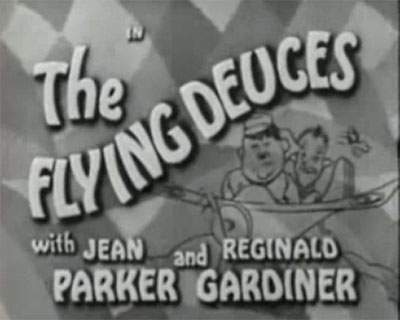
“The Flying Deuces” is a 1939 American comedy film directed by A. Edward Sutherland and starring Stan Laurel and Oliver Hardy. The film follows the misadventures of the duo, who join the French Foreign Legion in order to help Hardy forget about a woman he’s fallen in love with.

The film begins with Laurel and Hardy in Paris, where they meet a woman named Georgette (Jean Parker) who Hardy falls in love with. When Georgette tells Hardy that she is already married, he becomes distraught and decides to end his life. Laurel tries to stop him, and the two accidentally join the French Foreign Legion instead.

The rest of the film follows the duo’s escapades in the Legion, including Laurel’s attempts to help his friend forget about Georgette and Hardy’s various attempts to escape. The film features many of Laurel and Hardy’s trademark physical comedy and slapstick humor, as well as several musical interludes.

Overall, “The Flying Deuces” is a classic Laurel and Hardy film that showcases the duo’s comedic talents and enduring appeal. The film is noted for its memorable scenes and hilarious one-liners, and remains a fan favorite to this day.

Directors:
A. Edward Sutherland

Writer:
Ralph Spence, Charley Rogers, Fred Schiller

Stars:
Stan Laurel, Oliver Hardy, Jean Parker

Rate this Movie

The Great Rupert (1950)

4/5 (1)

“The Great Rupert” is a 1950 American Christmas comedy film directed by Irving Pichel and starring Jimmy Durante, Terry Moore, and Rupert the Squirrel. The film tells the story of a struggling family living in a run-down apartment building who find unexpected help from a talented squirrel named Rupert.

The family, consisting of Pete (Tom Drake), his wife Polly (Moore), and their daughter, are behind on their rent and facing eviction. Meanwhile, a failed vaudevillian, Louie Amendola (Durante), and his partner, Frank Dingle (Frank Orth), have been hired to perform at a neighboring building. Louie discovers that Rupert has a knack for collecting money, and convinces the squirrel to help him steal from the tenants in the apartment building.

As the scheme unfolds, Rupert becomes a sort of guardian angel to the struggling family, sneaking money into their apartment and causing chaos for Louie and Frank. The film culminates in a heartwarming finale that sees the family’s fortunes turn around thanks to Rupert’s help.

“The Great Rupert” is a classic family film with plenty of laughs and heartwarming moments. The film is notable for its use of a trained squirrel in the title role, and for its talented cast, which includes the beloved comedian Jimmy Durante. The film has become a holiday classic and is still enjoyed by audiences today for its timeless message of hope and generosity.

Directors:
Irving Pichel

Writer:
László Vadnay, James O’Hanlon, Harry Crane

Stars:
Jimmy Durante, Terry Moore, Tom Drake

Rate this Movie

Million Dollar Kid (1944)

3/5 (1)

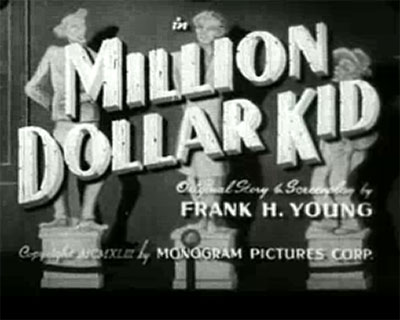
“Million Dollar Kid” is a 1944 American comedy film directed by Wallace Fox and starring the East Side Kids, a group of young actors who later became known as the Bowery Boys. The film is a part of the popular “East Side Kids” film series that was popular during the 1940s and 1950s.

The plot follows the East Side Kids as they stumble upon a wealthy businessman’s lost wallet containing a large sum of money. The businessman, Mr. Harmon (John Hamilton), offers a reward to whoever returns the wallet, but the East Side Kids decide to keep it and use the money to help out their neighborhood. However, they soon discover that the wallet actually belongs to a young boy named Tommy (David Gorcey), who needs the money for a life-saving operation.

The film features a lot of physical comedy, slapstick humor, and some heartwarming moments. The East Side Kids’ chemistry and comedic timing are on full display in this film, and it is considered to be one of the better entries in the “East Side Kids” series. The film also features a memorable performance by David Gorcey, who was the younger brother of Leo Gorcey, one of the main actors in the series.

Directors:
Wallace Fox

Writer:
Frank H. Young

Stars:
Leo Gorcey, Huntz Hall, Gabriel Dell

Rate this Movie

Charlie Chaplin – The Pawnshop (1916)

4/5 (1)

“The Pawnshop” is a 1916 American silent comedy film directed by and starring Charlie Chaplin. The film follows Chaplin’s character, the Little Tramp, as he works in a pawnshop. The plot revolves around various comedic situations that arise from the customers and items that come into the shop.

The film features several memorable scenes, including the Little Tramp trying to fix a clock, a customer trying to sell a stolen revolver, and a hilarious confrontation between the Little Tramp and an ornery customer (played by fellow comedian Henry Bergman). The film also includes a romantic subplot involving a beautiful customer (played by Edna Purviance), who catches the Little Tramp’s eye.

As with many of Chaplin’s films, “The Pawnshop” is notable for its physical comedy and innovative use of visual gags. It also features Chaplin’s trademark slapstick humor and his ability to infuse humor into even the most mundane situations.

Overall, “The Pawnshop” is a classic example of early silent comedy and remains a popular and entertaining film today. It is widely considered to be one of Chaplin’s best short films and is a testament to his enduring legacy as a comedic genius.

Directors:
Charles Chaplin

Writer:
Charles Chaplin, Vincent Bryan, Maverick Terrell

Stars:
Stars
Charles Chaplin, Henry Bergman, Edna Purviance

Rate this Movie

Bowery Blitzkrieg (1941)

3/5 (1)

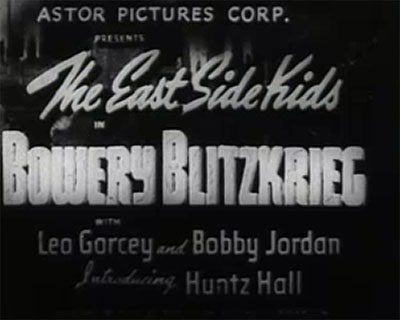
“Bowery Blitzkrieg” is a 1941 American film directed by Wallace Fox and starring the comedy team of the Bowery Boys. The film is a part of the popular “Bowery Boys” film series that was popular during the 1940s and 1950s.

The plot revolves around the Bowery Boys, led by their leader Muggs (Leo Gorcey), who get caught up in a scheme involving a crooked boxing promoter named “Longy” (Huntz Hall). Longy is involved in a plot to fix a boxing match and has hired a group of thugs to help him. The Bowery Boys are initially recruited to work for Longy, but they eventually realize that they are being used and decide to take matters into their own hands.

The film features a lot of physical comedy, slapstick humor, and some boxing action scenes. It also has some musical numbers and romantic subplots. The Bowery Boys’ chemistry and comedic timing are on full display in this film, and it is considered to be one of the better entries in the “Bowery Boys” series.

Directors:
Wallace Fox

Writer:
Brendan Wood, Donn Mullahy, Sam Robins

Stars:
Leo Gorcey, Bobby Jordan, Huntz Hall

Rate this Movie

Uncle Joe (1941)

3/5 (1)

“Uncle Joe” is a 1941 American comedy film directed by Howard Estabrook and starring Edward Everett Horton, Mona Freeman, and Charles Halton.

The movie follows the story of a young girl named Mary (Mona Freeman), who is sent to the countryside by her mother to avoid the advances of an artist. While there, she meets her uncle Joe (Edward Everett Horton), who is an eccentric inventor, and four country boys. They all band together to try to help a family friend who is facing foreclosure by the bank. Along the way, they encounter various comical situations and mishaps as they try to come up with a plan to save the farm and stop the foreclosure.

The film is a lighthearted comedy with a focus on the importance of family and community, and it features a talented cast of character actors.

Directors:
Howard M. Railsback, William Strohbach

Writer:
G.M. Rohrbach, Al Weeks

Stars:
Slim Summerville, Zasu Pitts, Gale Storm

Rate this Movie

Good Morning Boys (1937)

4.67/5 (3)

“Good Morning Boys” is a 1937 British comedy film directed by Marcel Varnel and starring Will Hay, Graham Moffatt, and Martita Hunt. The film follows the misadventures of Dr. Benjamin Twist (Hay), a bumbling schoolteacher who is recruited to become the headmaster of a troubled boys’ school.

Upon arriving at the school, Dr. Twist discovers that the students are completely out of control and that the staff is incompetent. With the help of his young assistant Albert (Moffatt) and a sympathetic teacher named Miss Poppy Dickey (Hunt), Dr. Twist sets about reforming the school and bringing discipline to the unruly students.

As they work to turn the school around, Dr. Twist and his team must also deal with a gang of ruthless criminals who are attempting to steal a valuable diamond that is hidden somewhere on the school grounds. With the help of his quick wit and clever schemes, Dr. Twist manages to outsmart the criminals and save the day.

The film is known for its clever dialogue and slapstick humor, as well as the endearing performances of its cast. It was a commercial success upon its release and remains a beloved classic of British comedy.

Directors:
Marcel Varnel

Writer:
Anthony Kimmins, Val Guest, Leslie Arliss

Stars:
Will Hay, Martita Hunt, Peter Gawthorne

Rate this Movie

Thunder in the City (1937)

3/5 (1)

“Thunder in the City” is a 1937 British film directed by Marion Gering and starring Edward G. Robinson and Nigel Bruce. The film follows the story of Dan Armstrong (Robinson), an American businessman who travels to Britain to convince the locals to invest in his new venture – a project to build a new type of aircraft.

Upon arriving in Britain, Armstrong is met with skepticism from the locals, who are wary of his brash American ways. However, he manages to win over some influential people, including Sir Christopher Strong (Bruce), a wealthy aristocrat with a passion for aviation. Together, they work to promote Armstrong’s new aircraft to the British public, but they face stiff competition from a rival company.

As Armstrong and Sir Christopher battle to win over investors, they also find themselves competing for the affections of Lady Edwina Esketh (Constance Bennett), a glamorous socialite who is torn between her love for Sir Christopher and her attraction to Armstrong.

The film explores themes of ambition, competition, and romance, and features some stunning aerial footage of early aviation. Although it received mixed reviews upon its release, “Thunder in the City” is now considered a classic example of British cinema from the 1930s, and it remains a popular choice for fans of vintage movies.

Directors:
Marion Gering

Writer:
Robert E. Sherwood, Aben Kandel, Ákos Tolnay

Stars:
Edward G. Robinson, Nigel Bruce, Constance Collier

Rate this Movie

The Taming of the Shrew (1929)

4/5 (2)

“The Taming of the Shrew” is a 1929 American pre-code romantic comedy film directed by Sam Taylor and starring Mary Pickford and Douglas Fairbanks. The movie is an adaptation of William Shakespeare’s play of the same name.

The film follows the story of a wealthy merchant named Baptista who has two daughters, Bianca and Katherine. While Bianca is sweet and popular, Katherine is known for her sharp tongue and stubbornness, earning her the nickname “the shrew.” Baptista has declared that Bianca cannot marry until Katherine is wed, and so several suitors attempt to win her over, to no avail.

Meanwhile, Petruchio, a young man from Verona, arrives in town looking for a wealthy wife. Hearing about Katherine’s wealth, he sets his sights on her and sets out to tame her. He engages in a battle of wills with Katherine, employing various strategies to break her spirit and make her more submissive.

Despite initial resistance, Katherine eventually begins to soften towards Petruchio, and the two eventually marry. At their wedding, Katherine delivers a speech about the duties of a wife, revealing that she has truly been tamed.

The film was praised for its performances by Pickford and Fairbanks, as well as for its lively and colorful set designs. However, it has also been criticized for its portrayal of Katherine as a shrew who needs to be “tamed” by a man. Nonetheless, “The Taming of the Shrew” remains a popular and influential film adaptation of Shakespeare’s play.

Directors:
Sam Taylor

Writer:
William Shakespeare, Sam Taylor

Stars:
Mary Pickford, Douglas Fairbanks, Edwin Maxwell

Rate this Movie

Charlie Chaplin in The Vagabond (1916)

4/5 (1)

“The Vagabond” is a silent film written, directed, produced by and starring Charlie Chaplin. The movie was released in 1916 and tells the story of a wandering musician who falls in love with a beautiful gypsy woman.

In the film, Chaplin plays the role of a street musician who performs for a living. One day, he comes across a group of gypsies who have been injured in a fight with a rival group. He helps them and is rewarded with a meal and a chance to perform for them.

While performing, the musician sees a beautiful young gypsy woman, played by Edna Purviance. He falls in love with her and decides to stay with the gypsy caravan, leaving his old life behind. However, he soon discovers that the gypsies are being mistreated by a cruel and abusive leader, played by Eric Campbell.

Determined to help the gypsies, Chaplin’s character comes up with a plan to free them from the tyrannical leader. In a dramatic and suspenseful sequence, he fights Campbell’s character and saves the gypsy woman.

The film ends with the musician and the gypsy woman leaving together, while the rest of the gypsies celebrate their freedom. “The Vagabond” was a critical and commercial success, and is considered one of Chaplin’s most important early films.

Directors:
Charles Chaplin

Writer:
Charles Chaplin, Vincent Bryan, Maverick Terrell

Stars:
Charles Chaplin, Edna Purviance, Eric Campbell

Rate this Movie

Boy! What a Girl! (1946)

3/5 (1)

“Boy! What a Girl!” is a 1946 musical comedy film directed by Arthur Dreifuss. The film stars Tim Moore as a porter named Sam, and former chorus girl, Lucille Ball, as a dancer named Terry. The film also features The Peters Sisters, a singing and dancing trio, and various other performers.

The plot of the film revolves around Sam’s attempts to help Terry achieve her dream of becoming a Broadway star. Terry is working as a taxi dancer at a local nightclub, but she dreams of bigger and better things. Sam, who is also an aspiring songwriter, sees potential in Terry and decides to help her by writing a song for her and getting her an audition with a Broadway producer.

Despite various setbacks and misunderstandings, including a case of mistaken identity that results in Sam being taken for a gangster, Sam and Terry eventually succeed in their mission. Terry impresses the Broadway producer with her singing and dancing skills, and Sam’s song is picked up for the show.

The film features several musical numbers, including a lively tap dance routine by Ball, and several performances by The Peters Sisters. The film is a light-hearted and entertaining romp that showcases the talents of its stars and provides a glimpse into the world of 1940s show business.

Directors:
Arthur H. Leonard

Writer:
Vincent Valentini

Stars:
Tim Moore, Elwood Smith, Duke Williams

Rate this Movie

Pygmalion (1938)

4.5/5 (2)

“Pygmalion” is a 1938 film adaptation of George Bernard Shaw’s play of the same name. The movie was directed by Anthony Asquith and Leslie Howard and stars Leslie Howard as Professor Henry Higgins and Wendy Hiller as Eliza Doolittle.

The film follows the story of Eliza Doolittle, a Cockney flower girl who is taken under the wing of Professor Henry Higgins, a phonetics expert. Higgins makes a bet with his friend Colonel Pickering that he can transform Eliza’s speech and manners and pass her off as a refined lady in high society.

Over the course of several months, Higgins and Pickering work tirelessly with Eliza, teaching her proper diction and behavior. Eliza’s transformation is successful, and she is able to pass as a member of high society at a ball. However, Eliza is also frustrated with Higgins’ rude and condescending behavior towards her, and she decides to leave him and strike out on her own.

In the end, Eliza returns to Higgins, but on her own terms. She has gained a sense of self-confidence and independence, and she no longer needs Higgins’ help. The movie ends with Eliza telling Higgins that she is leaving to marry Freddie, a young man who has fallen in love with her.

Overall, “Pygmalion” is a witty and charming movie that explores themes of class, language, and independence. It has become a classic of British cinema and a timeless story of self-discovery and transformation.

Directors:
Anthony Asquith, Leslie Howard

Writer:
George Bernard Shaw, W.P. Lipscomb, Cecil Lewis

Stars:
Leslie Howard, Wendy Hiller, Wilfrid Lawson

Rate this Movie